December 9, 2021
West Chester (December 9, 2021) — State Senator Carolyn Comitta today issued the following statement in response to Tower Health’s announcement that the sale of Jennersville Hospital and Brandywine Hospital to Canyon Atlantic will not take place. Tower Health now plans to close Jennersville Hospital on December 31, 2021, and Brandywine Hospital on January 31, 2022.
“To say I feel disappointed, frustrated, and even angry by news of the sudden reversal of course by Tower Health is an understatement. When it was announced that Jennersville would close, our legislative delegation, local municipalities, and county commissioners worked and acted sincerely and in good faith to do everything in our power to save it. When it was announced, days before Thanksgiving, that Tower had found a new buyer for both Jennersville and Brandywine, we took them at their word. When we raised questions about Canyon Atlantic, a largely unknown entity, we were met first with reassurances and later with silence.
Now, to learn that the sale will not go through and both hospitals will close feels like a betrayal. What the people of Chester County need and deserve is an honest, open, dedicated, and patient-centered approach to keeping both hospitals open as vital community health assets.
Like all our elected officials, I remain committed to saving both hospitals and finding solutions to preserve quality and affordable healthcare, emergency, and acute services. Like patients and employees, I am extremely concerned that by Tower raising our hopes and then dashing them just two weeks before Christmas, we have lost precious time.
Finally, please know that we will continue to work at the local, county, and state levels to address the vital and heightened urgency of this issue. And though our communities, leaders, and residents here in Chester County may have lost faith in Tower Health, given these developments, it seems that the very least it can do is delay the closures of both hospitals. In the spirit of the season and the spirit of its mission statement – ‘advancing the health and transforming the lives of the people it serves’ – Tower Health has a moral obligation to, at the bare minimum, keep these hospitals open until we can find a solution for those who rely on them.”
December 8, 2021
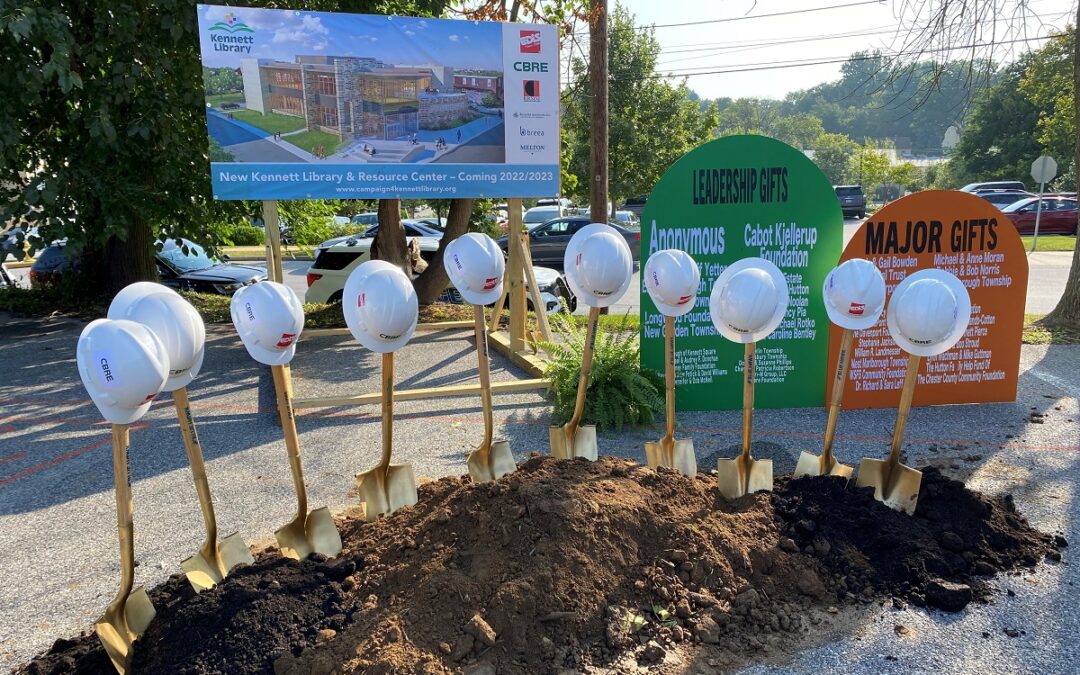
WEST CHESTER (December 8, 2021) – State Senator Carolyn Comitta announced today that she has helped secure $1.9 million in state funding for the new Kennett Library and Resource Center, a nearly 31,500-square-foot facility set for the corner of State and Willow Streets in Kennett Square.
“Education is the most powerful force for transformational change in the world,” said Comitta, an educator by trade and a member of the Senate Education Committee. “And I know that this new library and state-of-the-art resource center will be a place where children, families, residents, senior citizens, and community members can come together to learn, grow, and succeed for decades to come.”
The new Kennett Library and Resource Center, set for the corner of State and Willow Streets, will offer ample opportunity for residents and visitors to explore our cultural history and share life stories and experiences. Plans for the LEED-Gold certified facility call for a large adult library, a spacious children’s and teen space and study, quiet areas for private reading and reflection, and various-sized classrooms and flexible community rooms, all equipped with state-of-the-art audio/visual equipment, laptop, and computer access, as well as expanded digital communications technology. The facility will also include two Maker Spaces, equipped with 3D printers, large format scanner and printer, embroidery machines and computers with design software to foster creativity for both adults and children, and a resource for companies and organizations. In addition, it will offer a 110-seat auditorium for performances, discussions, meetings, and film screenings.
Located in the heart of historic downtown Kennett Square, the modern building is designed with large swaths of glass to allow abundant natural light and Avondale brown stone to reflect the region’s heritage and landscape. It will include outdoor common spaces, a sweeping second-floor terrace, and 19 off-street parking spaces. In addition to making room for an expanded book and media collection, the new facility will allow for the library to vastly expand its programming to launch new and build on existing offerings regarding adult literacy, English as a Second Language, student learning and tutoring, arts and culture, historical, and community discussion programs. The building design also incorporates energy-efficiency measures and modern health and safety systems. Perhaps most importantly, the new library will be free, open, and accessible to all, including vulnerable populations, like lower-income families, elderly residents, and those with disabilities.
Established over a century ago, the Kennett Library currently serves 45,000 residents in eight Chester County municipalities including the Borough of Kennett Square, as well as the townships of East Marlborough, Kennett, New Garden, Newlin, Pennsbury, Pocopson, and West Marlborough.
Ground was broken for the new $20 million facility in August and the organization has already raised nearly $12.5 million through public and private donations. The current facility, located just west of the new site at 216 E. State Street, is 60 years old and only 11,000 square feet.
The Redevelopment Assistance Capital Program (RACP) is a Commonwealth reimbursement grant program administered by the Office of the Budget for the acquisition and construction of regional economic, cultural, civic, recreational, and historical improvement projects. RACP projects are authorized in the state budget, have a regional or multi-jurisdictional impact, and generate substantial increases or maintain current levels of employment, tax revenues, or other measures of economic activity.
To learn more about the new Kennett Library, visit https://campaign4.kennettlibrary.org/.

December 6, 2021
WEST CHESTER (December 6, 2021) – State Senator Carolyn Comitta announced $2 million in state funding for the construction of a new office building in Tredyffrin that will support hundreds of new high-wage jobs.
The funds will support the construction of a new corporate headquarters for Equus Capital Partners, a real estate investment manager that acquires and develops office, multi-family, industrial, research and development, and retail assets.
The shovel-ready project, planned for a 10-acre site on Swedesford Road, will be the first mass-timber office headquarters in the Philadelphia market. It also calls for a two-story parking structure. Upon completion, the new building will support 660 new, high-paying jobs.
“It’s important that we continue to support projects that bring new investment and job opportunities to our region while utilizing renewable materials and sustainable building practices,” Comitta said.
The Redevelopment Assistance Capital Program (RACP) is a Commonwealth reimbursement grant program administered by the Office of the Budget for the acquisition and construction of regional economic, cultural, civic, recreational, and historical improvement projects. RACP projects are authorized in the state budget, have a regional or multi-jurisdictional impact, and generate substantial increases or maintain current levels of employment, tax revenues, or other measures of economic activity.

December 6, 2021
WEST CHESTER (December 6, 2021) – The Chester County Council, BSA will receive $750,000 in state funding for the construction and installation of expanded shower facilities at its Camp Horseshoe Scout Reservation in West Nottingham Township.
The funding, secured by state Senator Carolyn Comitta, will support the installation of three separate shower houses, as well as an additional 17 shower stalls in an existing shower house. Each of the proposed shower houses will include seven private, gender-neutral combination bathroom/shower stalls, in addition to the new shower stalls created through the renovation and modernization of the existing shower house. Both these parts of the project will help better serve all campers and leaders.
“Scouting has a rich heritage of developing character and leadership skills in our young people and it’s important that those opportunities are available and open to all children and teens,” Comitta said. “I support the Chester County Council, BSA in welcoming and encouraging equity and diversity in scouting programs and activities. These investments will help ensure that more young people can access and enjoy the wonders of summer camp while maintaining an emphasis on health and inclusivity.”
Last year, the Chester County Council, BSA was forced to close its camps due to the pandemic. With increased scout membership, camps experienced a surge in attendance this year and are already seeing more reservations for 2022. In response, the Council is now working to modernize its facilities to accommodate all campers with gender-neutral amenities.
Rated a top BSA camp in the area, Camp Horseshoe is located on the Mason-Dixon line separating Pennsylvania and Maryland, its name is derived from the Octoraro Creek, a tributary of the Susquehanna River, that makes a meandering 4-mile horseshoe through the property. The camp offers a multitude of scouting programs and opportunities, including more than 50 merit badges, a computer lab, STEM offerings, various outdoor activities, and programs for first-year and older scouts alike.
The Chester County Council, BSA is the local operation of Scouts, BSA (formerly the Boy Scouts of America), serving Chester County, Pennsylvania and the northwestern corner of Cecil County, Maryland. With a charter dating back to 1919, the Council has a rich heritage of developing character and leadership skills in youth, recently celebrating its 100th Anniversary. It serves nearly 5,000 youth annually through thousands of dedicated, talented volunteers and a small number of professional staff and it partners with over 110 community organizations to deliver quality scouting programs.
In 2018, the Scouting program began serving both boys and girls from kindergarten through fifth grade. The Scouts, BSA program launched in February 2019 and serves boys and girls, ages 11 to 18, thus allowing more young people than ever before to experience the benefits of a time-tested program that builds character and leadership.
The Redevelopment Assistance Capital Program (RACP) is a Commonwealth reimbursement grant program administered by the Office of the Budget for the acquisition and construction of regional economic, cultural, civic, recreational, and historical improvement projects. RACP projects are authorized in the state budget, have a regional or multi-jurisdictional impact, and generate substantial increases or maintain current levels of employment, tax revenues, or other measures of economic activity.
December 6, 2021
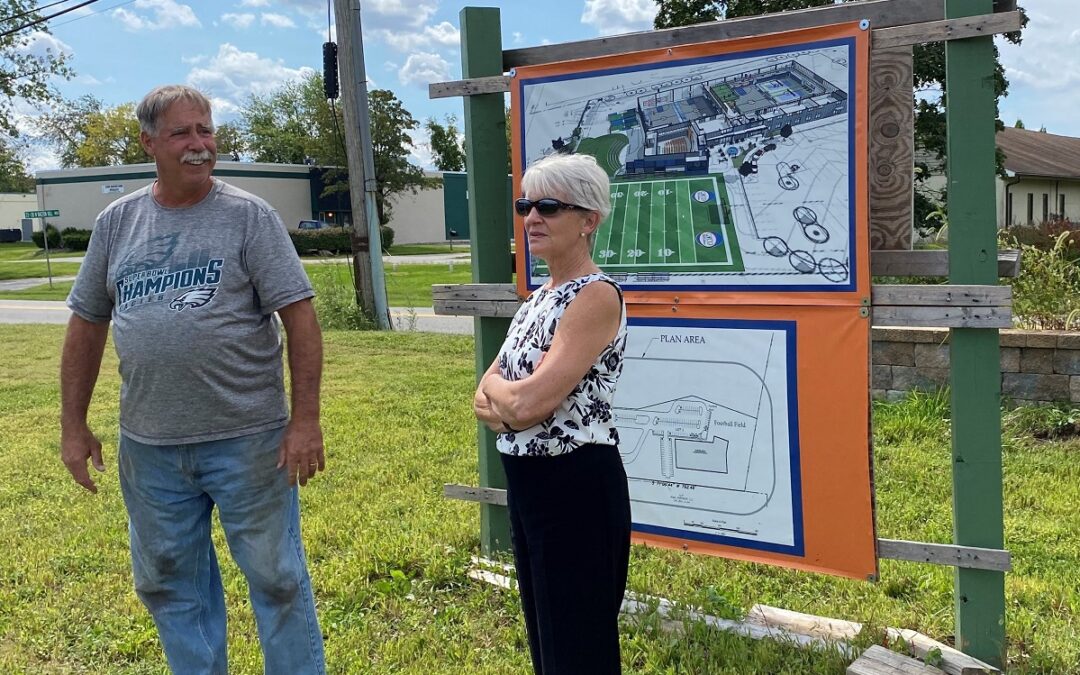
WEST CHESTER (December 6, 2021) – The Great Valley Community Organization (GVCO) will receive $750,000 in state funding for the construction of a new, state-of-the-art community center.
The funding, secured by state Senator Carolyn Comitta, will support the construction of a more than 40,000 square-foot community featuring multiple indoor sports courts, an outdoor field, a café, an elevated track and workout area, an indoor performance venue, and an outdoor amphitheater, as well as multipurpose rooms for community programs, activities, and events.
Site development and preparation work is currently underway for the center, which is planned for a seven-acre location at 17-19 N. Bacton Hill Road in East Whiteland.
“I am proud to support funding for the new Great Valley Community Center, a place where residents, families, and young people can come together to participate in athletic, artistic, creative, and career-oriented activities with a focus on health, safety, and empowerment,” Comitta said. “I thank all of the staff, volunteers, patrons, and donors who continue to work to make the new center a reality. I look forward to its completion, and have no doubt that these investments will pay dividends in the future of our young people and our community.”
GVCO is a nonprofit organization dedicated to building a strong, vibrant, and connected community by providing facilities, activities, and programs enriching the lives of all local residents. Thousands of families have participated in the organization’s activities and many of the Great Valley Area School District’s students take part in GVCO’s youth sports offerings, including basketball, football, sideline cheer, volleyball, crew, and competitive cheer.
Since its inception in 2001, it has expanded to include tutoring, arts, senior programs, community, and educational events as well as new sports to serve the entire Great Valley community. Previously, the organization had been operating out of a smaller, 10,000-square-foot facility on Bacton Hill Road, but population growth and the growing demand for expanded programs limited its offerings.
GVCO is currently undergoing a $3 million capital campaign to support the center’s construction. Learn more at www.gvco.org
December 6, 2021
WEST CHESTER (December 6, 2021) – State Senator Carolyn Comitta today added to her growing record of support for Coatesville’s revitalization, announcing an additional $2 million in state funding for the parking and transportation facility adjacent to the site of the new Coatesville Train Station.
The latest funding comes in addition to $650,000 in state multimodal transportation grant funding she helped secure for the project in the spring and a $1 million Redevelopment Assistance Capital Program (RACP) grant she announced last year.
“I know residents have been eagerly awaiting this project and construction is finally beginning,” Comitta said. “As we move forward with building the new train station and look forward to making Coatesville’s revitalization a reality, I am fully committed to supporting continued investments in the future of Chester County’s only city – a future that must include economic growth and job opportunity for residents of Coatesville and the surrounding region. This funding is just one more piece of the puzzle in that ongoing effort.”
The funding was awarded to the Redevelopment Authority (RDA) of the City of Coatesville, which is working to construct the parking facility to support the train station, widely considered a lynchpin of the city’s ongoing revitalization plans and strategic economic development vision.
The multi-level 175,000 square foot parking facility is key to the success of the train station, which currently offers Amtrak service but is expected to provide SEPTA Regional Rail service in the future.
The facility will also feature bus transportation integration, covered waiting shelters, bike racks, ample lighting, wayfinding signage, and nearly 500 parking spaces to support SEPTA, Amtrak, and Link and Kraft Bus transportation services
The multimodal commuter parking facility set for Fleetwood Street is estimated to cost more than $10 million.
Meanwhile, officials recently broke ground on the new train station with construction set to get underway soon. The revitalization project is slated to be completed by 2025 and is funded by support from Federal Transit Administration, PennDOT, and Chester County.
Prior to project design and bidding, PennDOT led multiple planning efforts with the Coatesville community to identify strategies that would revitalize the area surrounding the proposed train station. Streetscape projects on Third Avenue and Fourth Avenue completed in 2019 and 2020 improved access from Coatesville’s downtown area to the proposed new train station location.
The Redevelopment Assistance Capital Program (RACP) is a Commonwealth reimbursement grant program administered by the Office of the Budget for the acquisition and construction of regional economic, cultural, civic, recreational, and historical improvement projects. RACP projects are authorized in the state budget, have a regional or multi-jurisdictional impact, and generate substantial increases or maintain current levels of employment, tax revenues, or other measures of economic activity.

December 2, 2021
WEST CHESTER (December 2, 2021) – Two Chester County initiatives aimed to prevent gun violence are slated to receive more than $2 million to total state grant funding, state Senator Carolyn Comitta announced.
The funding, which comes through the Pennsylvania Commission on Crime and Delinquency (PCCD)’s Violence Intervention and Prevention (VIP) grant program, supports local programs to stop gun violence in neighborhoods and reduce community violence through outreach and violence interruption programs.
In Chester County, the grants that received initial approval are as follows:
- $1,520,092 to West Chester University to increase access to evidence-based, trauma-informed behavioral health care for youth and young adults in Coatesville, Pottstown, Norristown, and Reading. Mental health care providers will deliver mobile therapy via telehealth or in-person at sites in at-risk communities.
- $500,000 to the Youth Mentoring Partnership in Exton to support, expand, and enhance its mentoring, safe haven and social-emotional learning programs for middle and high school youth 11-19 years of age. It will also support reentry efforts from incarceration, through access to healthcare, stable housing, educational opportunities, and meaningful employment.
Comitta, a member of the bicameral PA Safe Caucus, said the investments will support proven strategies and programs to prevent and reduce gun violence at the community level.
“Everyone in every community deserves to live and thrive in a healthy, safe, and peaceful environment,” Comitta said. “It is critical that we invest in the efforts of our local groups and organization that are working directly with residents and on the frontlines of the crisis of gun violence. In addition, this funding offers direct and targeted support and mental health resources for those in underserved communities.”
“Gun violence is a scourge that cuts right to the heart of our communities. We must do more to prevent violence in our commonwealth and stop the trauma of violence from blighting our future,” said Governor Tom Wolf. “These grants will provide communities and local organizations with necessary resources to disrupt violence, promote healing and make our communities safer. This funding is an important next step in tackling the gun violence epidemic and reducing violence in our communities.”
Mark Mintzer, CEO of Youth Mentoring Partnership said, “The funds provided by the Commonwealth’s VIP anti-violence grant program come at an immensely critical time for the families and communities we serve. These resources will allow us to expand our collaborative efforts, including those in the greater Coatesville Area, providing vulnerable youth with additional trauma-informed mentors, safe havens, and our unique 3G social-emotional learning curriculum. Special thanks to Senator Carolyn Comitta and Chester County Commissioner Marian Moskowitz and their offices for their support around these initiatives.”
The Chester County programs come as part of $15.7 million in total grant funding initially approved to support 40 projects and programs to stop gun and community violence statewide.
More information about the VIP and PCCD’s efforts to address gun violence, can be found under the Gun Violence tab on www.pccd.pa.gov.
###

November 29, 2021
WEST CHESTER (November 29, 2021) – State Senator Carolyn Comitta will host a healthcare enrollment townhall with experts from Pennie, the official health insurance marketplace for Pennsylvania, and the Pennsylvania Association of Community Health Centers (PACHC) on Monday, December 6, 2021, at 7 p.m. at West Chester Borough Hall.
Comitta, who serves on the Senate Health and Human Services Committee, encouraged anyone who has questions about shopping for health insurance to attend. <<REGISTER NOW>>
“The pandemic has highlighted the importance of having healthcare coverage to protect your health and your budget. And Pennie is the one-stop-shop for options and resources to find the coverage you need to access quality, affordable care,” Comitta said. “If you have questions or feel overwhelmed with the idea of shopping for healthcare, please consider attending our townhall, so you can hear directly from experts about all the available options to apply, shop, and enroll.”
Anyone can buy insurance through Pennie and the other ACA marketplaces, but they are typically designed for people who do not have insurance through an employer, and are not eligible for Medicare, which covers seniors and people with disabilities, or Medicaid, which is for low-income individuals and families. Currently, there are nearly 344,000 Pennie customers throughout Pennsylvania.
The open enrollment period for coverage through Pennie is now underway. If you sign up by December 15, you’re guaranteed to be covered by the New Year. Those who sign up after December 15 will start coverage February 1, 2022.
Townhall attendees will hear from Zachary Sherman, Pennie Executive Director, and Erik Huet, Pennie’s Legislative Liaison, about Pennsylvania’s healthcare marketplace and the many resources available. Following the presentation and Q&A with Senator Comitta and her guests from Pennie, individuals will be able to speak one on one with staff from PACHC to learn more about specific options available to them and their families.
“Pennie’s 2022 Open Enrollment Period runs from November 1 to January 15, 2022, with December 15 marking the deadline for coverage beginning New Year’s Day. All uninsured Pennsylvanians, even those who previously thought health coverage was unobtainable, should visit Pennie.com or attend a local townhall event to see how things have changed,” said Zach Sherman, Pennie Executive Director. “I look forward to joining Senator Comitta to discuss Pennie’s offerings and options that are available to improve the financial security and peace of mind of our customers.”
As a result of the American Rescue Plan, affordable coverage has never been more accessible for so many Pennsylvanians. Nine out of 10 Pennie customers qualify for savings which have increased in value for low-income individuals, working families, and near-retirees.
Individuals interested in attending the ACA/Pennie Healthcare Enrollment Townhall can register at www.pasenatorcomitta.com/aca.
For those who cannot make it in person, the event will be livestreamed on the Senator’s Facebook page www.facebook.com/SenatorComitta and www.pasenatorcomitta.com/live/
November 22, 2021
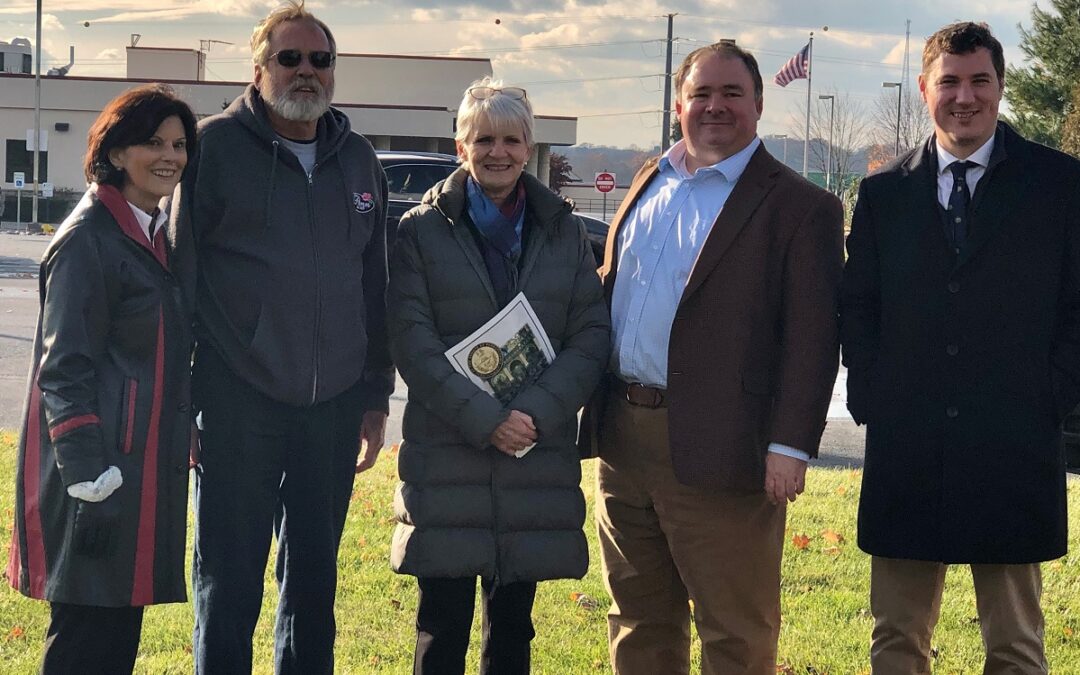
WEST GROVE – Rep. John Lawrence was joined by state Senator Senator Carolyn Comitta, Chester County Commissioners Marian Moskowitz, Josh Maxwell, and Michelle Kichline, Penn Township Supervisor Victor Mantegna, and other local officials at the Penn Township Building earlier today to announce the continued operation of Jennersville Hospital. The hospital had been slated for closure at the end of the year by its current owner, Tower Health.
“Today’s announcement is welcome news for our community,” said Rep. John Lawrence. “For the past seven weeks, we have worked night and day to find a solution to keep this facility open for the people of our community, and keep this Emergency Room open for the acute medical needs of our area. I am so grateful for each person that contacted my office to voice their support, and especially to the hardworking first responders with Medic 94, Union Fire Company, and West Grove Fire Company, who serve our community with such dedication. Keeping the Jennersville ER open is critical both for them and our community.”
“This is a win for the community that was driven by the community – the residents, patients, staff, doctors, nurses, and medical personnel served by and employed by Jennersville Hospital,” said state Senator Carolyn Comitta. “They spoke up and stood up. Together, we worked with various stakeholders to amplify their voices and ensure that this vital community asset and center for medical and emergency care in southern Chester County is preserved. I want to thank our local municipalities, the Chester County Commissioners, our bipartisan legislative delegation, the Pennsylvania Department of Health, and Tower Health for finding a solution to save Jennersville Hospital.”
Canyon Atlantic Partners will assume ownership and operation of Jennersville Hospital effective Jan. 1, 2022. The announcement follows Tower’s previous decision to close Jennersville at the end of 2021. Based in Reading, Tower Health purchased five local hospitals, including Jennersville Hospital, for $423 million in 2017.
Chester County Commissioners Marian Moskowitz, Josh Maxwell and Michelle Kichline said, “Confirmation that hospital services, especially emergency treatment, will continue at Jennersville and Brandywine is excellent news, and we are grateful to the leadership at Tower Health for working to find a way to keep the operations going. Together with Representative Lawrence and Senator Comitta, we have been trying to secure ways to keep Jennersville and Brandywine open. We look forward to working with the new hospital operator to ensure the range of healthcare services continue.”
Lawrence, Comitta, and Moskowitz participated in numerous calls and in-person meetings after Tower’s abrupt late-September closure announcement. A particular focus developed in keeping the Emergency Room open, with alternate facilities more than 40 minutes away. Recent population increases and the growth of senior living options across the southern part of the county also contributed to the need to find a solution.
“Jennersville Hospital has faithfully provided for the health, safety and welfare of southern Chester County residents for over 100 years,” said Victor Mantegna, Chair of the Penn Township Board of Supervisors. “The news of its imminent closure was both devastating and constituted a substantial threat to our community at large, PA State Police, and emergency services. Today is a great day as we celebrate the continued presence of this health providing organization in the community of Penn Township. On behalf of the Penn Supervisors, community of Penn and our neighboring townships throughout southern Chester County, I would like to thank our PA Department of Health, Senator Comitta, Representative Lawrence, our Chester County Commissioners, Board of Supervisors, staff and Tower Health for working diligently together to preserve our Jennersville Hospital with this sale. We look forward to continuing our close partnership with Jennersville Hospital and working hand in hand with its new owners for years to come as we continue to work to keep our community healthy, safe, and well.”
###

November 22, 2021
WEST CHESTER (November 22, 2021) – Residents, businesses, and families who wish to give back to children and families in need this holiday season can donate to Toys for Tots of Chester and Southern Montgomery Counties via a drop box located at the district office of state Senator Carolyn Comitta.
Now through December 15th, new and unwrapped toys can be dropped off at the atrium of 17 East Gay Street in downtown West Chester. The office is open during regular business hours, Monday through Friday, from 9 a.m. to 5 p.m.
Residents can also stop by one of Senator Comitta’s mobile/senior outreach offices to drop off their donations.
“Every child deserves the opportunity to experience the joy and magic of the holiday season,” state Senator Carolyn Comitta said. “For nearly 75 years, Toys for Tots and its volunteers, and donors have been working to make that happen. This year, I am again thrilled to support their efforts. The season of gift-giving is here, and I thank everyone who helps spread the cheer to those in need.”
In addition, donations are accepted and encouraged at any number of Toys for Tots collection sites throughout the area. To find a collection site, visit https://chester-county-pa.toysfortots.org/
Donations may include new and unwrapped toys such as:
- Dolls/Barbies
- Stuffed animals
- Art, Jewelry, Nail and Craft Kits
- Board games/Puzzles
- Action figures
- Radio control cars/trucks
- Hand-held electronics
- Sporting goods
- Books
- STEM Science kids
- Legos
This year, so far, Toys for Tots of Chester and Southern Montgomery Counties has received applications for nearly 15,000 children. In addition to providing gifts for younger children, the group also collects and distributes holiday gifts to young people and teens up to 18 years old.
In fact, according to organizers, gifts for older children and teens, including those between ages 8 and 10 and 10 and up, tend to be needed. To close the gap, the organization often utilizes donated funds to purchase age-appropriate gifts for them, such as books, games, makeup and nail polish sets, inexpensive (but not gaudy) jewelry, cologne and perfume sets, and electronics like LED lights and Blue-tooth headphones.
While toy and gift donations for all ages are appreciated, organizers also ask that supporters not donate clothes as they cannot distribute them and must be passed along to other appropriate local agencies.
Toys for Tots of Chester and Southern Montgomery Counties serves all of Chester County, as well as a small portion of Montgomery County centered on Norristown that is not covered by another campaign.
According to its website, last year the group collected and distributed 20,161 toys to 10,227 children.
Since 1947, Toys for Tots distributes toys to children from homes that cannot afford to buy gifts for the holidays. In that time 604 million toys have been collected and distributed to 272 million children.
The program is a 501(c)(3) not-for-profit public charity run by the United States Marine Corps Reserve Foundation. According to its website, it remains a top-rated charity, with more than 97 percent of donations going directly to its mission of providing toys, books, and other gifts children in need. The 3 percent spent on support principally covers fundraising expenses — not one donated dollar goes to salaries or any other manpower costs.

November 19, 2021
WEST CHESTER (November 19, 2021) – State Senator Carolyn Comitta and state Rep. Christina Sappey announced that more than $2.5 million in state funding has been awarded to four projects in Chester County that will enhance transportation safety and expand opportunities for outdoor recreation.
“Continued investments in our transportation infrastructure, our trail network, and access to our preserved open space will pay dividends in the health, safety, well-being, and overall quality of life in our Chester County communities,” Comitta said. “These projects represent exciting opportunities for more residents, families, and visitors to enjoy everything our region has to offer.”
“I’m thrilled that this funding has been approved to support outstanding local projects. These grants increase safety and traffic flow, connect communities by trail, conserve open space and provide recreation opportunities,” said Sappey. “I was pleased to support these applications for funding and look forward to seeing the results.”
The projects, approved today by the Commonwealth Financing Authority, are financed through two sources, the Multimodal Transportation Fund, and the Greenways, Trails and Recreation Program.
The projects are as follows:
- $1.47 million from the Multimodal Transportation Fund for streetscape improvements along Birch Street and construction of a railroad underpass as part of the Kennett Greenway Project. The greenway project calls for a 14 mile multi-purpose trail loop connecting the greater Kennett area, including New Garden and East Marlborough township communities. The proposed railroad underpass will include a new 10-foot-wide multi-use trail approaching an 8-foot high by 12-foot-wide underpass, to be located beneath the East Penn Railroad, with pedestrian lighting.
- $1 million for West Bradford Township through the Multimodal Transportation Fund for traffic safety improvements at the intersection of Marshallton-Thorndale Road and Poorhouse Road.
- $100,000 for New Garden Township through the Greenways, Trails and Recreation Funds to support rehabilitation efforts at St. Anthony’s in the Hills. Phase I of rehabilitation includes adding accessible paved trail and parking, sidewalks, recreation features and sustainable improvements. In 2019, Sappey helped the township secure $60,000 in funding for the acquisition of the property.
- $25,000 for Natural Lands Trust in Greenways, Trails and Recreation Funds for improvements to the bridge at the Stroud Preserve that connects the parking lot to the Preserve and trail system.
The Multimodal Transportation Fund provides grants to encourage economic development and ensure that a safe and reliable system of transportation is available to the residents of the commonwealth. Eligible projects include the development, rehabilitation and enhancement of transportation assets to existing communities, streetscape, lighting, sidewalk enhancement, pedestrian safety, connectivity of transportation assets and transit-oriented development.
Act 13 of 2012 established the Marcellus Legacy Fund and allocates funds to the CFA for planning, acquisition, development, rehabilitation and repair of greenways, recreational trails, open space, parks and beautification projects using the Greenways, Trails and Recreation Program.
The CFA was established in 2004 as an independent agency of the Department of Community and Economic Development to administer Pennsylvania’s economic stimulus packages. The CFA holds fiduciary responsibility over the funding of programs and investments in Pennsylvania’s economic growth. Unique among state agencies in structure and scope, the CFA consists of seven board members: four legislative appointees and the secretaries of DCED, the Office of the Budget, and Department of Banking and Securities.

November 19, 2021
WEST CHESTER (November 19, 2021) – State Senator Carolyn Comitta and state Rep. Kristine Howard announced today that nearly $700,000 in state funding has been awarded to improve the intersection of Phoenixville Pike and Yellow Springs Road/Sidley Road in East Whiteland Township
The funding, approved today by the Commonwealth Financing Authority (CFA), will support widening the intersection to create turning lanes and upgrading the traffic signal to enhance safety and reduce congestion.
“This investment will improve safety at a key intersection that is traveled each day by many students, parents, teachers, and staff at Great Valley High School and Middle School, as well as employees and commuters working in business centers along the Route 202 corridor,” Comitta said. “I strongly support this and other investments in our transportation system as part of an ongoing local, statewide, and national push to upgrade our infrastructure.”
“This grant is an investment and commitment from the state to update our aging infrastructure,” Howard said. “It will go a long way to improve a key economic area of our region and meet both current and future needs.”
The Multimodal Transportation Fund provides grants to encourage economic development and ensure that a safe and reliable system of transportation is available to the residents of the commonwealth. Eligible projects include the development, rehabilitation and enhancement of transportation assets to existing communities, streetscape, lighting, sidewalk enhancement, pedestrian safety, connectivity of transportation assets and transit-oriented development.
The CFA was established in 2004 as an independent agency of the Department of Community and Economic Development to administer Pennsylvania’s economic stimulus packages. The CFA holds fiduciary responsibility over the funding of programs and investments in Pennsylvania’s economic growth. Unique among state agencies in structure and scope, the CFA consists of seven board members: four legislative appointees and the secretaries of DCED, the Office of the Budget, and Department of Banking and Securities.

November 19, 2021
WEST CHESTER (November 19, 2021) – Habitat for Humanity of Chester County and the Coatesville 2nd Century Alliance were awarded more than $91,000 in total state funding to support their ongoing efforts to provide affordable housing and energize growth and development in Coatesville, state Senator Carolyn Comitta said.
The funding was awarded through the Pennsylvania Department of Community and Economic Development’s Neighborhood Assistance Program (NAP), which supports nonprofit, business, and residential projects in distressed areas or low-income neighborhoods.
The program has five main components: The Neighborhood Assistance Program (NAP), Special Program Priorities (SPP), the Neighborhood Partnership Program (NPP), the Charitable Food Program (CFP), and the Enterprise Zone Program (EZP).
Habitat for Humanity of Chester County (HfHCC) in Coatesville was awarded $11,250 from the Special Program Priorities (SPP). The SPP aims to assist low-income families facing high rental rates, improve living conditions in the community, and boost growth and development.
HfHCC will use the funds to construct homes at Cambria Terrace, an affordable housing development in the city. In 2021-22, volunteers will complete a new home and start three more in the Cambria neighborhood that will provide four low-income families with affordable homeownership.
The Coatesville 2nd Century Alliance was awarded $80,000 from the Neighborhood Partnership Program (NPP) for the downtown revitalization in the City of Coatesville. Projects are designed to improve access to job and economic opportunities, quality education, affordable housing, quality-of-life amenities, and other key factors in building healthy communities.
The funds will be used to support the alliance’s fourth year of its downtown revitalization plan, focusing on the retention, celebration, and promotion of the existing business base. The alliance plans to employ creative strategies to encourage new patrons such as engaging social media, special events, and coupon vouchers underwritten by NPP funds. In addition, the NPP funding will support façade improvement grants, a systemized, reliable, and regular street cleanup program, and collaborative partnerships with the city to address blighted and vacant buildings.
Senator Comitta, who recently helped mark the groundbreaking of the new Coatesville Train Station, welcomed continued investments in the city’s ongoing revitalization.
“Ensuring that our neighborhoods and communities are safe, healthy, and welcoming for all begins with supporting affordable quality housing opportunities and revitalizing our downtowns, main streets, and local business districts,” Comitta said. “These programs also offer Coatesville residents, community members, and business owners an opportunity to play a leading role in their future success and growth.”
“Communities from every corner of Pennsylvania will benefit from this funding – the result of public-private partnerships and cooperation,” said Gov. Wolf. “We are pleased to continue supporting NAP applicants who are committed to advancing and improving communities by making thoughtful plans to address the issues impacting their neighborhoods. These projects make the state stronger as a whole and keep it the best place to live, work, and play.”
“NAP funding can support improved community health, property renovations, address food security and blight, and so much more in neighborhoods throughout the commonwealth,” said Department of Community and Economic Development Secretary (DCED) Dennis Davin. “This program is incredibly valuable in encouraging public-private partnerships that lead to community improvements and a better quality of life for Pennsylvanians.”
NAP encourages private sector investment into projects that will help improve financially distressed communities by providing tax credits to businesses that donate capital to support projects that address neighborhood and community problems. NAP can be used for projects in categories including affordable housing, community services, crime prevention, education, job training, charitable food, blight, special population issues, veteran’s initiatives, and long-term community revitalization
This year’s program also provided for COVID-19 and social justice-related assistance. In recognition of the unprecedented level of challenges these events posed for residents of the commonwealth, a special emphasis was placed upon, and priority was given, to projects that sought to address critical issues related to the pandemic, its aftermath and recovery, social justice and support for policy changing movements, and improving opportunities for marginalized populations.
The Coatesville projects come as part of sixty community investments through NAP in the southeast Pennsylvania region to address blight and improve safety, housing, and commercial development. Other projects updated community revitalization plans, increased financial literacy, improved community gardens, and promoted healthy communities.
Statewide, this round of NAP funding provided nearly $36 million in total investments to 220 community revitalization projects across the Commonwealth.
More info about the NAP program.
###
November 8, 2021
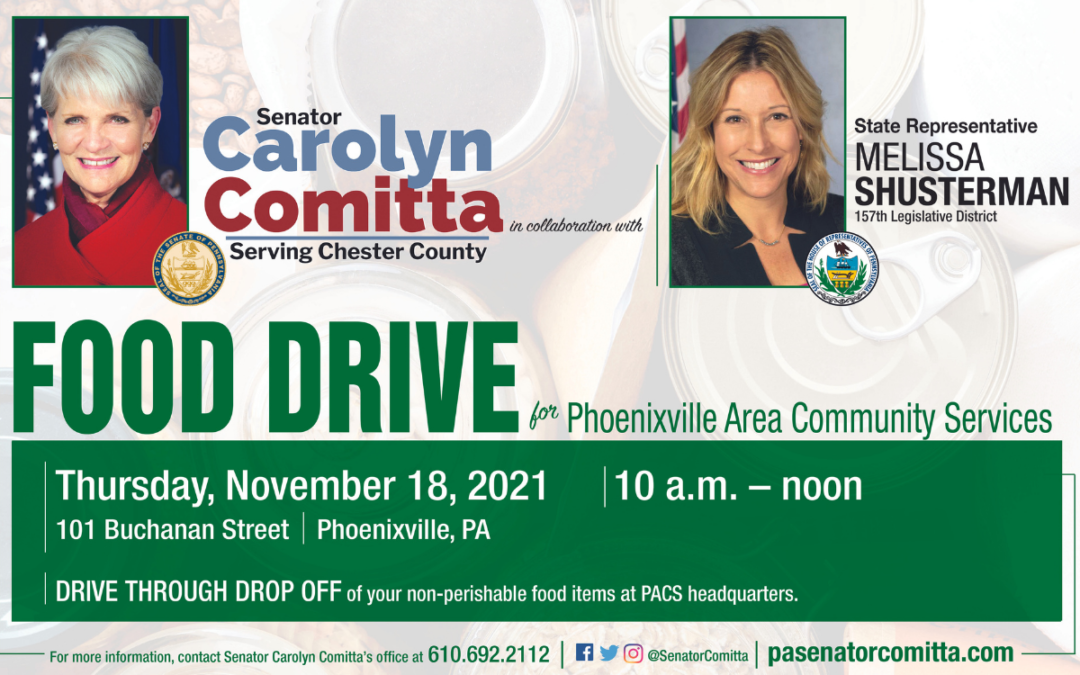
WEST CHESTER (October 20, 2021) – State Senator Carolyn Comitta and state Representative Melissa Shusterman are organizing a food drive this November to benefit residents, families, and seniors in need throughout the Phoenixville area.
Donations can be dropped at Phoenixville Area Community Services (PACS), located at 101 Buchanan Street in Phoenixville, on Thursday, November 18 from 10 a.m. to noon. Drive-through contactless drop-off is available.
All nonperishable food, cleaning and personal care items are appreciated, provided they are unopened and unexpired.
Holiday needs, include:
- Stuffing
- Gravy (packets)
- Instant mashed potatoes
- Cake mix
- Canned:
- Sweet potatoes
- Fruit
- Green beans
- Corn
- Cranberry sauce
- Cereal
- Vegetable oil and canola oil
- Cleaning supplies
- Toilet paper, tissue, and paper towels
- Diapers and pull-ups
“Food insecurity has become a greater concern for many households during this pandemic. No family should have to worry about putting food on the table,” state Senator Carolyn Comitta said. “I appreciate PACS and all our local agencies for working to support and uplift Chester County families during these difficult times. As we approach the holidays, I encourage those who can to donate, volunteer, or help out in any way possible. Together, we can ensure that the joy of the holiday season reaches every corner of the community.”
State Representative Melissa Shusterman added, “Food insecurity has the potential to affect anyone. I am so pleased to partner with Senator Comitta to facilitate this food drive to help those in need. No one deserves to go hungry, and I know our community is eager to support our most vulnerable.”
Since 1972, Phoenixville Area Community Services, a registered nonprofit organization has served as a food pantry, meal provider, referral service and food security resource for residents of Phoenixville and the surrounding region.
At the onset of the pandemic in 2020, their work was more important than ever. PACS received over 45,000 requests for food, five times their usual requests for assistance. PACS has also served to assist over twelve local agencies and nonprofits with food security concerns.
Learn more about their PACS’ mission or how to donate at www.pacsphx.org.

November 8, 2021
WEST CHESTER (November 8, 2021) – A package of four bills aimed at strengthening protections for students and preventing and combating sexual assault on college campuses has been introduced in the Pennsylvania legislature, state Senator Carolyn Comitta said.
Comitta, a member of the Pennsylvania Commission for Women, the Women’s Health Caucus, and the Senate Education Committee, is a strong supporter and co-sponsor of the four-bill package, which is part of the governor’s “It’s On Us PA” initiative.
“We all have an important role to play in reframing the conversation on sexual assault, empowering victims, and creating a safe, healthy, and welcoming environment for all,” said Comitta. “As legislators, it is our duty to support students and equip our higher education institutions with the tools necessary to prevent and stop sexual assault and violence on campuses.”
The bills are as follows:
- Senate Bill 730, sponsored by Senator Amanda Cappelletti and House Bill 1489, sponsored by Rep. Brian Sims, also known as the “Yes Means Yes” Law. It requires all postsecondary institutions in Pennsylvania to adopt policies with clear standards of what is and is not consent. The bill also increases access to comprehensive, coordinated, and confidential support and services for victims of sexual violence, dating violence, domestic violence, and stalking.
- Senate Bill 909, sponsored by Senator Steve Santarsiero and House Bill 1699, sponsored by Representative Karen Boback. The bills strengthen protections for victims of on-campus crime by requiring postsecondary institutions to provide written notification of rights, services, accommodations, and protective measures to students and employees who may be victims of dating violence, domestic violence, sexual assault, or stalking. In addition, they call for schools to provide protective accommodations or measures to victims regardless of whether they choose to file a police report.
- Senate Bill 785, sponsored by Senator Judith Schwank and House Bill 1490, sponsored by Representative Jessica Benham. This legislation requires schools to provide instruction to 7-12 grade students on how to identify and prevent dating violence, sexual assault, sexual harassment, and stalking to help prepare and equip young people for safe and healthy futures.
- Senate Resolution 122, sponsored by Senator Vincent Hughes and House Resolution 108, sponsored by Representative Carol Hill-Evans. The resolutions call for creating a task force on secondary and postsecondary campus sexual assault and relationship violence. The taskforce, under the Joint State Government Commission, would focus on identifying, comparing, and analyzing the prevention and response policies of different educational settings relating to sexual harassment, sexual assault, dating violence, domestic violence, and stalking. In addition, it would evaluate the benefits or deficiencies of the use of response and prevention programs in postsecondary institutions.
Governor Wolf added, “We have made a lot of progress in combatting sexual violence and harassment in schools, but we need to do more to ensure all of our students are safe. These four legislative proposals are the next step to preventing assaults and violence and ensuring victims get the help they deserve. I commend the legislators joining me in this fight and urge the leadership in the General Assembly to quickly take up this legislation for a vote and send it to my desk.”
“The Pennsylvania Commission for Women is grateful for this new legislation that will help mitigate sexual misconduct on campus. This legislation has the power to protect so many young women and students who are at risk,” said Pennsylvania Commission for Women Executive Director, Moriah Hathaway. “We are proud to support the It’s On US PA campaign and encourage everyone to take the pledge. We will continue to work with the Pennsylvania Coalition Against Rape, the Governor’s Office, and the General Assembly to advocate for women and girls in Pennsylvania.”
“The Pennsylvania Coalition Against Rape is grateful to join Governor Wolf in support of survivors of campus sexual assault. The It’s On Us PA legislative package will help strengthen sexual assault prevention and response on college campuses throughout the state and ensure students impacted by sexual assault and abuse have access to the support of rape crisis centers,” said Karen Baker, CEO, Pennsylvania Coalition Against Rape.
It’s on Us PA is a statewide campaign that invites everyone to play a role in ending sexual assault on college campuses. Launched by the Wolf administration in 2016, the Pennsylvania program is modeled on the success of the national It’s On Us campaign, an initiative of the Obama-Biden White House. It aims to effectively address and counter the culture of sexual assault on campus by opening a larger conversation about recognizing, identifying, and intervening in situations where consent has not or cannot be given. To date, two of the governor’s It’s on Us PA initiatives have been enacted.
In addition, the administration has also provided $5 million in It’s On Us PA grants to 190 public and private post-secondary schools to help change the culture on campus.
###
November 5, 2021
WEST CHESTER (November 5, 2021) – Residents who want to weigh in on the Pennsylvania Department of Environmental Protection’s (DEP) plans to remediate environmental contamination at the site of the former Bishop Tube facility in East Whiteland Township have until Monday, November 8, to register for a virtual public hearing.
DEP is holding the virtual public hearing on Tuesday, November 9 at 6:30 p.m. Residents must register at least 24 hours in advance by e-mailing RA-EP-SEROECB@pa.gov. A link will be provided upon registration and oral comments will be limited to five minutes.
For those interested in only listening, access information is available at https://www.dep.pa.gov/PublicParticipation/Pages/Virtual-Public-Hearings.aspx
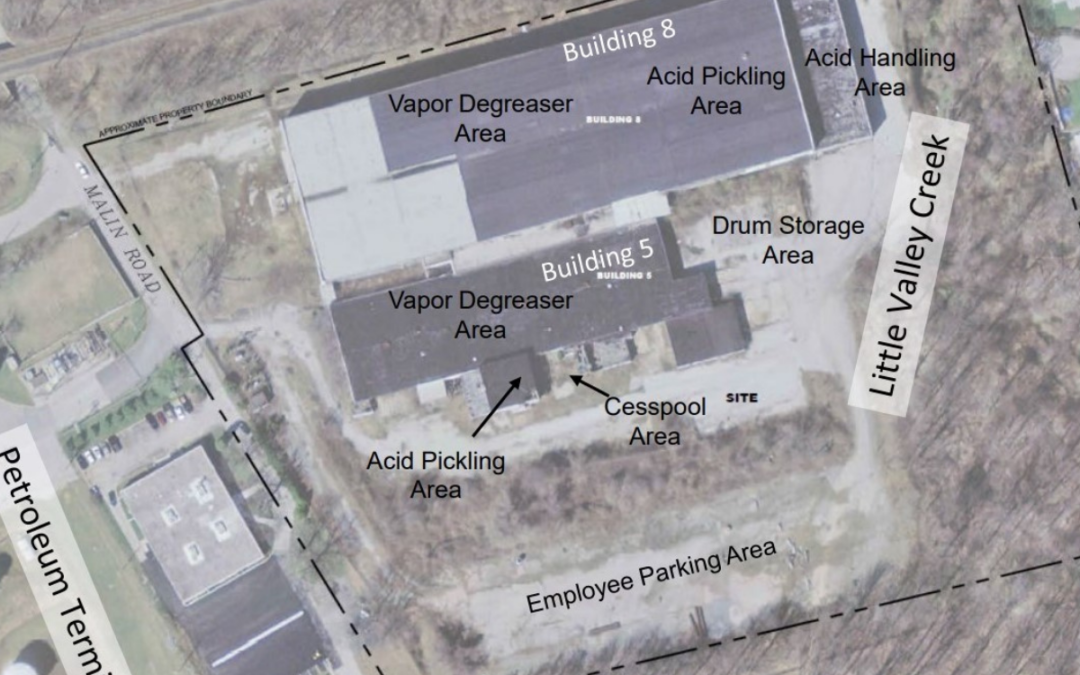
DEP is proposing a remedial response action to address soil, groundwater, and surface water contamination, as well as an impacted residential drinking water supply at the 13.7-acre site where several industrial businesses manufactured stainless steel tubes and seamless stainless steel products from the 1950s until 1999.
Hazardous substances were employed in the manufacturing processes throughout the history of site, such as chlorinated solvents, including trichloroethene (TCE). TCE, a commercial-grade solvent that was commonly used as a degreasing agent for manufactured metal parts, is the primary source of concern that led to soil contamination and groundwater impacts. In addition, other contaminants have been detected at the site, including elevated levels of fluoride, chromium, aluminum, and nickel. However, according to DEP, the TCE concentrations within soil, groundwater, and surface water are generally higher than other chlorinated solvents at the site and it poses the most substantial threat to human health and the environment. Besides being a known carcinogen, prolonged exposure to TCE can result in serious neurological, cardiac, reproductive, and developmental health problems.
Under the authority of the Hazardous Sites Cleanup Act, DEP is proposing to remediate the site to a combination of background, statewide health, and site-specific standards in accordance with the Land Recycling Program. After considering several courses of action, DEP is proposing a combination of in situ chemical injections, soil mixing, engineering practices, institutional controls, and long-term monitoring to address the soil, groundwater, and surface water contamination. The residences with the impacted well would be connected to an existing public water line.
The injection of chemical oxidants creates a chemical reaction that destroys harmful contaminants and produces harmless byproducts. It is commonly described as “in situ” because it is conducted in place, without having to excavate soil or pump out groundwater for aboveground cleanup.
<<Visit DEP’s Bishop Tube Page for More Info on the Proposal>>
According to DEP Secretary Patrick McDonnell, the $8.1 million proposed plan would protect public health and the environment and is more cost-effective than other considered alternatives.
State Senator Carolyn Comitta, minority chair of the Department of Environmental Resources and Energy Committee, is encouraging residents to review the plan and submit their comments.
“Over the years, residents and business owners have raised questions and expressed ongoing concerns about the future of this site,” she said. “It’s important that community members understand DEP’s proposed remediation plan and have an opportunity to weigh in, ask questions, and get answers.”
In addition to the public hearing, residents can submit public comment in writing until January 31, 2022. Written comments can be submitted by sending them via mail to Dustin A. Armstrong, Department of Environmental Protection, 2 East Main Street, Norristown, PA 19401, or by email to RA-EP-SEROECB@pa.gov. Please include “Bishop Tube Public Comment” in the subject of the email.
All comments, whether delivered orally during the virtual hearing or submitted in writing carry equal weight and consideration with DEP.
October 25, 2021
WEST CHESTER (October 25, 2021) – Residents interested in officially weighing on Aqua Pennsylvania’s plans to raise water and wastewater rates have until Friday, November 5 at 4 p.m. to sign up to participate in a series of telephone public input hearings scheduled by the Pennsylvania Public Utility Commission.
The telephone hearings are scheduled for the following dates and times:
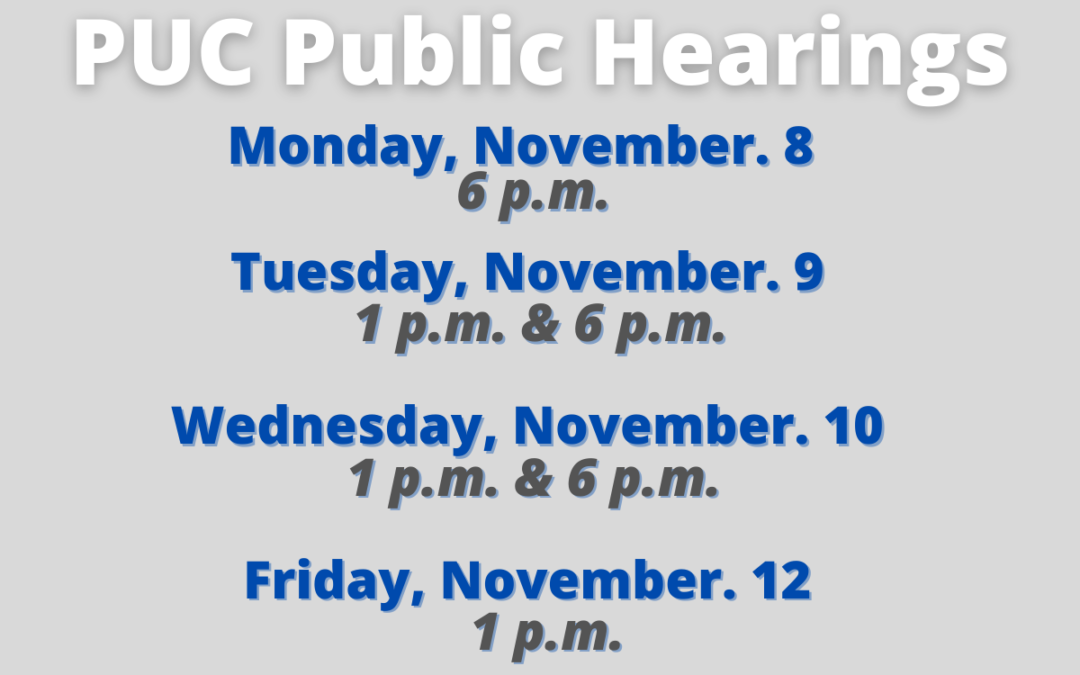
- Monday, Nov. 8, 2021 – Hearing will begin at 6 p.m.
- Tuesday, Nov. 9, 2021 – Hearings will begin at 1 p.m. and 6 p.m.
- Wednesday, Nov. 10, 2021 – Hearings will begin at 1 p.m. and 6 p.m.
- Friday, Nov. 12, 2021 – Hearing will begin at 1 p.m.
PUC Administrative Law Judge Mary D. Long will preside over the hearings.
Aqua Pennsylvania’s proposed rate increase would raise average monthly residential water bills by up to 17 percent and average monthly wastewater bills by nearly 33 percent. Under the proposals, the average monthly bill for a residential water customer using 4,000 gallons per month would increase by $11.97, from $69.35 to $81.32. The average monthly bill for a residential wastewater customer would increase $18.44 (33.2%) from $55.51 to $73.95.
Those interested in participating in the hearings must register via email or by phone in advance to submit public input.
Registering by Email:
To pre-register by email, please email Judge Long’s legal assistant, Daniela Alban at dalban@pa.gov, and provide the following information:
- Your first and last name.
- The date and time of the hearing at which you wish to testify.
- The phone number you will be using to call into the public input hearing.
- If you require an interpreter to participate in the hearing, the language of the interpreter.
Registering by Telephone:
To pre-register by phone, please call Judge Long’s office at 412-565-3550 and leave a message providing the following:
- Your first and last name.
- The date and time of the hearing at which you wish to testify.
- The phone number you will be using to call into the public input hearing.
- A phone number where you can be reached prior to the hearing if we need to contact you.
- Your email address, if you have one.
- If you require an interpreter to participate in the hearing, the language of the interpreter.
Providing Written Public Comment:
If you wish to submit written public comment, you may write a letter or complete the proposed comment form and send it to the Pennsylvania Public Utility Commission, P.O. Box 3265, Harrisburg, PA 17105.
State Senator Carolyn Comitta, who has already written to the PUC in opposition to the increases, encouraged impacted residents and families to sign up for the hearings and make their voices heard. She plans to offer testimony at the November 9 public hearing.
Aqua Water provides water service to approximately 434,264 customers in portions of more than 200 municipalities throughout 32 Pennsylvania counties. Aqua Wastewater provides wastewater service to approximately 40,284 customers in portions of more than 40 municipalities throughout 15 Pennsylvania counties. Collectively, the two companies serve nearly 1.5 million people throughout the Commonwealth, including many in Chester County and southeastern Pennsylvania.
Aqua Pennsylvania’s last rate increase was filed in 2018 and became effective in 2019. It resulted in average water customers experiencing a nearly 10 percent increase and wastewater average customers shouldering a nearly 35 percent hike.
For more information on the ratemaking process, call the PUC at 1-800-692-7380 or visit the PUC website.
October 21, 2021
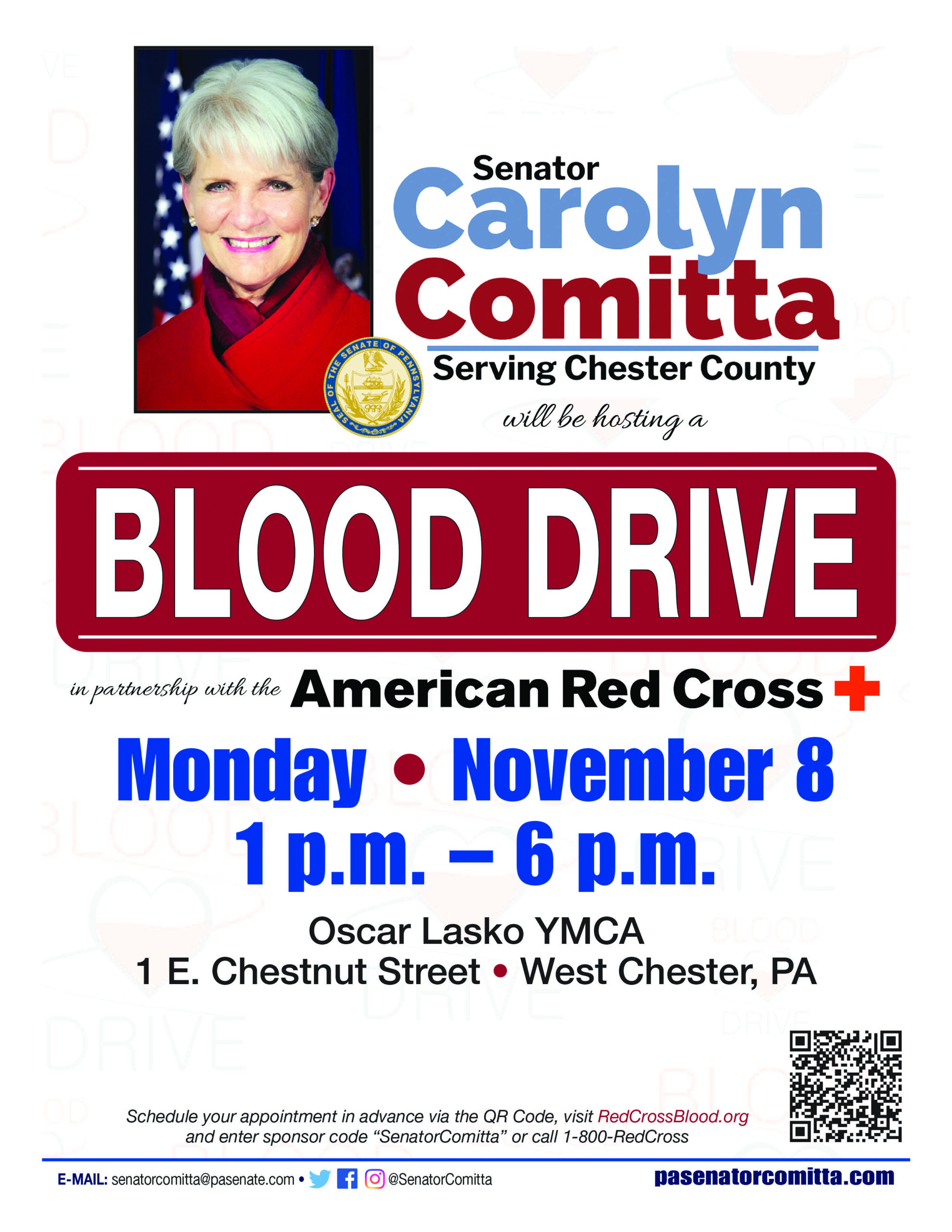
UPDATE: Unfortunately, the Red Cross has been forced to postpone the Blood Drive scheduled for November 8 at the Oscar Lasko YMCA.
We are working to reschedule it and will keep you posted of a new date. In the meantime, we still encourage eligible donors to give blood. You can find donation opportunities in our area at www.redcrossblood.org
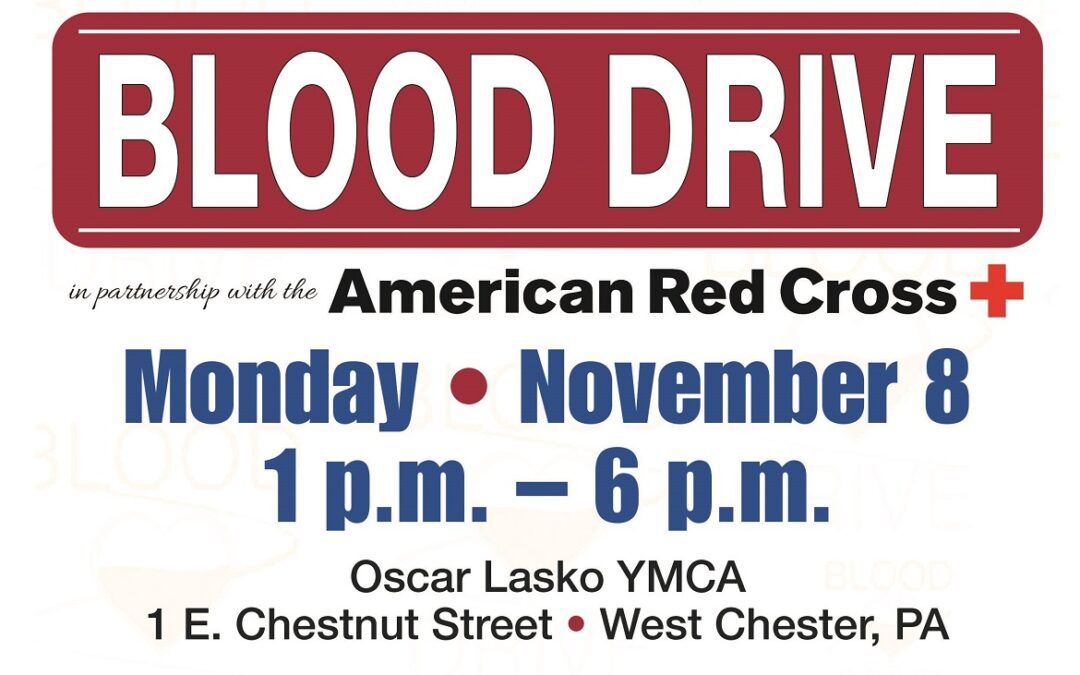
WEST CHESTER (October 21, 2021) – In response to an ongoing blood shortage, state Senator Carolyn Comitta in partnership with the American Red Cross and the Oscar Lasko YMCA is hosting a blood drive on Monday, November 8 from 1 p.m. to 6 p.m.
The blood drive will take place at the Oscar Lasko YMCA, 1 East Chestnut Street in West Chester.
Interested donors are encouraged to schedule their appointment in advance via the American Red Cross’s website and enter sponsor code “SenatorComitta” or call 1-800-RedCross. Walk-ins will be accepted based on availability.
“Blood donations are always needed, but since the onset of the pandemic there has been an even greater need,” said Senator Comitta. “Critical blood shortages are being felt across the state and nation. By donating blood, you can support an individual with a chronic illness, traumatic injury, or in need of life-saving surgery.”
According to the American Red Cross, which supplies 40 percent of the nation’s blood supply, donor turnout recently reached the lowest levels of the year and the blood supply has dropped to the lowest it has been at this time of year since 2015.
 While blood product distributions to hospitals remain strong, significantly outpacing blood donations in recent weeks, the Red Cross needs to collect 10,000 additional blood products each week over the next month to overcome the current shortage and meet the needs of patients in hospitals across the country.
“There is a critical shortage of blood across Pennsylvania and the nation, as COVID-19 has prevented some donors from giving blood and impacted the scheduling of blood drives,” Acting Physician General Dr. Denise Johnson said. “Blood is essential for surgeries, traumatic injuries, cancer treatment and chronic illnesses, which is why it is so important for individuals to go to their local blood bank or find a blood drive near them and donate. An adequate supply of blood is essential to ensure Pennsylvanians have safe, continuous access to the highest quality of health care.”
Approximately 36,000 units of red blood cells are needed every day in the United States. While blood donations are a critical and integral part of medical care, only about 3 percent of age-eligible people donate blood yearly. However, one donation can save up to three lives.
Many patients who have major surgeries will need a blood transfusion to replace blood lost during their procedure. Blood transfusions are also used for patients who have serious injuries from car crashes or natural disasters, and people with illnesses that cause anemia, like leukemia or kidney disease, will often receive blood transfusions.
The type of blood most commonly requested and used by hospitals is type O. Type O blood can be transfused to patients with any blood type, which is why it is often used in emergencies when there is not enough time to determine a patient’s blood type. Because only 7 percent of people in the U.S. are type O negative, it’s always in great demand and often in short supply.
The Red Cross has had less than a day’s supply of certain blood types in recent weeks. The supply of type O blood, dropped to less than a half-day supply at times over the last month − well below the ideal five-day supply
However, all blood types are needed to ensure there is a reliable supply.
Fall is typically a time when the blood supply rebounds from summer shortages as more students return to school and college and more donors are available, Comitta noted.
“I encourage all healthy, eligible donors to consider giving blood,” she said. “If you cannot, please help spread the word. Every donation can help save lives.”
Eligible donors must meet the following criteria to donate, you must be in good health and feeling well, must be at least 16 years old or older, and you must weigh at least 110 lbs.
More information on donor eligibility or to register online, visit www.redcrossblood.org.
October 20, 2021
WEST CHESTER (October 20, 2021) – State Senator Carolyn Comitta and state Representative Melissa Shusterman are organizing a food drive this November to benefit residents, families, and seniors in need throughout the Phoenixville area.
Donations can be dropped at Phoenixville Area Community Services (PACS), located at 101 Buchanan Street in Phoenixville, on Thursday, November 18 from 10 a.m. to noon. Drive-through contactless drop-off is available.
All nonperishable food, cleaning and personal care items are appreciated, provided they are unopened and unexpired.
Holiday needs, include:
- Stuffing
- Gravy (packets)
- Instant mashed potatoes
- Cake mix
- Canned:
- Sweet potatoes
- Fruit
- Green beans
- Corn
- Cranberry sauce
- Cereal
- Vegetable oil and canola oil
- Cleaning supplies
- Toilet paper, tissue, and paper towels
- Diapers and pull-ups
“Food insecurity has become a greater concern for many households during this pandemic. No family should have to worry about putting food on the table,” state Senator Carolyn Comitta said. “I appreciate PACS and all our local agencies for working to support and uplift Chester County families during these difficult times. As we approach the holidays, I encourage those who can to donate, volunteer, or help out in any way possible. Together, we can ensure that the joy of the holiday season reaches every corner of the community.”
State Representative Melissa Shusterman added, “Food insecurity has the potential to affect anyone. I am so pleased to partner with Senator Comitta to facilitate this food drive to help those in need. No one deserves to go hungry, and I know our community is eager to support our most vulnerable.”
Since 1972, Phoenixville Area Community Services, a registered nonprofit organization has served as a food pantry, meal provider, referral service and food security resource for residents of Phoenixville and the surrounding region.
At the onset of the pandemic in 2020, their work was more important than ever. PACS received over 45,000 requests for food, five times their usual requests for assistance. PACS has also served to assist over twelve local agencies and nonprofits with food security concerns.
Learn more about their PACS’ mission or how to donate at www.pacsphx.org.

October 19, 2021
WEST CHESTER (October 19, 2021) – 42 acres of farmland in Cochranville will be preserved thanks to state and county investments in agricultural land preservation, state Senator Carolyn Comitta said today.
The Mark A. & Claudia V. Cole farm, a 42-acre crop and livestock operation, received an investment of $8,994 from the Pennsylvania Farmland Preservation Program and $152,682 from the county program.
“Preserving local farms helps conserve open space, protect our environmental resources, and ensure access to healthy, nutritious, locally-grown food,” said Comitta, who serves on the Senate Agriculture and Rural Affairs Committee. “Agriculture is part of our heritage and our economic success in Chester County and Pennsylvania. These investments are important for all those reasons, as well as countering the encroaching pressures of development on our farms and rural areas.”
The preserved farmland comes as part of nearly 1,999 acres on 21 farms in 13 counties protected from future development today through the Commonwealth’s Farmland Preservation Program.
In total, the Cole farm, along with another farm located in Chester County, the Leila & Sander Lehrer farm, a 56-acre crop operation in Warwick Township, were awarded $18,861 in state and $497,728 in county farmland preservation investments.
“Farmland preservation provides a secure pathway for future generations to succeed,” said Secretary Redding. “It ensures future agriculturalists have land to farm, and in return, consumers will have food on the table. Once farmland goes out of production, it rarely comes back, which is why farmland preservation is so important.”
Pennsylvania leads the nation in both the number of farms and acres permanently preserved for agricultural production. The Farmland Preservation Program, also known as the Pennsylvania Agricultural Conservation Easement Purchase Program, was developed to strengthen Pennsylvania’s agricultural economy and protect prime farmland. This program enables state and county governments to purchase conservation easements from farmers
Since it was established in 1988, the program has invested more than $1.6 billion to purchase permanent conservation easements on 5,949 Pennsylvania farms, covering 603,646 acres, in 58 counties, ensuring they will remain farms in perpetuity.
A 2019 research study funded by the Pennsylvania Department of Agriculture and conducted by Dr. Thomas Daniels of the University of Pennsylvania, found the total economic impact of farmland preservation in Pennsylvania to be valued from $1.8 to $2.9 billion annually. The report also concluded environmental benefits of farmland preservation are estimated at an additional $1.9 billion annually.