December 16, 2024
West Chester, Pa (December 16, 2024) – West Chester University was awarded nearly $50,000 in state funding to support ongoing efforts to prevent and combat sexual assault on campus, state Senator Carolyn Comitta said.
The funding comes through It’s On Us PA, a statewide program administered by the Pennsylvania Department of Education (PDE) to support strategies and resources to stop sexual assault and misconduct on college campuses.
“Stopping sexual assault starts with changing the culture on campus. Through It’s On Us PA, we’re opening a larger conversation about recognizing, identifying, and intervening in situations where consent has not or cannot be given,” said Comitta, who serves on the Senate Education Committee. “We all have a role to play in ensuring our colleges, universities, and institutions of higher education are safe, healthy, and productive learning environments where everyone is treated with respect and dignity.
“As a West Chester University alumna, I commend the university, its staff, and students for being leaders in working to prevent and address sexual assault and misconduct,” she added.
The program brings together education leaders and all Pennsylvanians to be part of the solution in protecting students from sexual violence by raising awareness about sexual assault, teaching participants that assault includes non-consensual sex, advising them on how to identify dangerous situations, empowering them to intervene, and urging them to create an environment of support for victims and survivors.
Modeled on the success of the national It’s On Us campaign, in 2016 It’s On Us PA became the nation’s first statewide campaign to improve campus safety by supporting colleges and university communities in reframing the conversation around sexual violence and empowering them to develop solutions.
“PDE is committed to supporting efforts that keep college students and their campuses safe, inclusive, and welcoming for all students,” said Interim Acting PDE Secretary Angela Fitterer. “All Pennsylvanians deserve a safe learning environment, and the It’s On Us PA grant program cultivates change and provides colleges, universities, and postsecondary institutions with the support and resources necessary to protect learning environments and ensure they are free from sexual assault, harassment, and violence.”
The funding for West Chester University comes as part of more than $1.6 million in It’s On Us PA grants awarded to more than 44 colleges, universities, and other postsecondary institutions across the Commonwealth.
Eligible institutions and schools with 10,000 or fewer students were able to request up to $40,000; those with more than 10,000 students were able to apply for up to $60,000. Private licensed career schools that do not offer specialized associate degrees could request up to $10,000.
Since 2016, 301 It’s On Us PA grants totaling nearly $8.7 million to 100 post-secondary institutions across the state – including public and private two-year and four-year colleges and universities.
In the past, West Chester University and Lincoln University have received grant funding through It’s On Us PA.
Pennsylvanians are also invited to visit the It’s On Us PA webpage and take the pledge to “recognize that non-consensual sex is sexual assault, identify situations in which sexual assault may occur, intervene in situations where consent has not or cannot be given, and create an environment in which sexual assault is unacceptable and survivors are supported.”

December 12, 2024
Harrisburg, Dec. 12 — Members of the Chester County state legislative delegation are pleased to report a state and federal investment in keeping the Chesapeake Bay Watershed clean from its tributaries in Chester County.
The Chester County Conservation District was awarded more than $67,000 in funding directed by the Department of Environmental Protection.
“Investing in cleaning the waterways that flow into the Chesapeake Bay is more than an environmental effort – it’s a commitment to safeguarding a vital ecosystem, supporting local economies and preserving a legacy of natural beauty and abundance for generations to come,” said state Rep. Danielle Friel Otten, D-Chester.
The DEP awarded grants through the 2025 Countywide Action Plan (CAP) Implementation Grants to county teams across Pennsylvania’s share of the Chesapeake Bay Watershed.
“Stormwater runoff and agricultural runoff remain leading sources of water quality impairment in Chester County and Pennsylvania,” said state Sen. Carolyn Comitta, minority chair of the Senate Environmental Resources and Energy Committee. “These investments will help prevent pollution and restore and protect the local watersheds that are crucial to environmental health, public health, and the strong quality of life in our communities.”
Pennsylvania has made historic progress in the Chesapeake Bay watershed. Earlier this year, the Shapiro administration announced that for the first time in its history, the Chesapeake Bay showed steady overall improvement, earning a C+ grade from the University of Maryland’s Chesapeake Bay and Watershed Report Card – the highest grade ever awarded to the overall health of the Bay since the report was created.
“The Conservation District is a leader in environmental stewardship and I’m glad they’ve received this funding,” said state Rep. Christina Sappey, D-Chester. “They will work hard to assure the rivers, streams and creeks running through Chester County are clean and will not have a negative impact on the Chesapeake Bay Watershed.”
“Our environmental impact isn’t just local, as everything always flows downstream,” said state Rep. Dan Williams, D-Chester. “It’s imperative that we do our part here in Chester County to ensure that our waterways are clean and healthy. Not contributing to further pollution of the Chesapeake Bay is our moral obligation. The Chesapeake watershed is an ecological, cultural and recreational treasure that must be protected and continue to be restored.”
“I am extremely pleased to hear of PA DEP’s latest grant to help clean our county’s tributaries to the Chesapeake Bay,” said state Rep. Chris Pielli, D-Chester. “Our fragile ecosystem, local economy and overall health depends on this type of dedicated investment and regional cooperation to reverse decades of neglect and negative environmental impacts.”
State Rep. Paul Friel, D-Chester, said, “This funding in an important investment in our natural infrastructure- ensuring that our families, farms and communities have clean and healthy waterways for generations to come.”
“Protecting our watersheds, groundwater and waterways should be a top priority for all levels of government,” said state Sen. Katie Muth. “Pennsylvania’s waterways have been contaminated from decades of legacy pollution and industrial runoff and continue to face threats on every front from extraction operations, improper waste disposal, pollution runoff and pesticides. It is imperative that both state and federal governments provide adequate resources to continue to fund initiatives that protect and remediate our waterways and our watersheds in our region and across the Commonwealth. I genuinely appreciate the continued hard work of the Chester County Conservation District in all their efforts.”
The 2025 CAP Implementation Grants include $9.6 million from the state Environmental Stewardship Fund and $14.4 million in EPA funding, including $7.1 million in Infrastructure Investment and Jobs Act (IIJA) funds, to support counties’ implementation of their local priority initiatives in their CAPs.

December 10, 2024
West Chester, Pa (December 11, 2024) – State Senator Carolyn Comitta secured $25,000 in state funding to support Communities that Care of Greater Downingtown (CTC), a nonprofit organization that fosters positive mental health and youth development.
The funds, awarded through the Pennsylvania Department of Community and Economic Development, will support CTC’s development, public outreach, and communication efforts, as well as its HYPE (Health Youth Positive Energy) clubs at local schools.
“Communities That Care of Greater Downingtown is grateful to Senator Carolyn Comitta for her partnership and assistance in securing funding for CTC to continue providing prevention programs in the Downingtown community. Senator Comitta’s commitment to healthy communities and youth is critical in our mission to prevent substance abuse, promote mental health, and empower youth to make positive choices,” said Bethann Cinelli, D.ED., CTC Executive Director.
“As someone who grew up in Downingtown and attended Downingtown High School, I am grateful for the work that Communities That Care is doing to support, educate, and inspire young people to make healthy choices that lead to success in school and life,” said Comitta, who serves on both the Senate Education Committee and the Aging and Youth Committee. “I want to thank CTC staff, volunteers, supporters, and all the students working to support each other through its invaluable programs.”
With nearly 80 active members, HYPE students are working to create and promote healthy school communities through advocacy and leadership to prevent substance use and promote positive mental and emotional well-being. They raise awareness and engage youth in prevention initiatives through peer-to-peer messaging, sharing youth perspectives, social media, and sending consistent messages about the power of healthy choices.
HYPE student clubs currently operate with the guidance of dedicated faculty mentors at six Downingtown Area School District schools: the Marsh Creek 6th Grade Center, Lionville Middle School, Downingtown Middle School, Downingtown West High School, Downingtown East High School and the STEM Academy.
CTC is a coalition of organizations, businesses, schools, faith communities, law enforcement and healthcare providers that use evidence-based prevention programs and policies to create a safer, supportive community for youth and strengthen community collaboration in prevention efforts.
For more information about CTC or information on starting a HYPE club at your school, visit www.dtownctc.org
###

December 5, 2024
West Chester, Pa (December 4, 2024) – Plans for LCH Health and Community Services to open a pharmacy got a major boost this week thanks to state funding secured by state Senators Carolyn Comitta and John Kane.
The grant funding, awarded through the Pennsylvania Department of Human Services, will support the nonprofit community health organization in providing outpatient medications to low and lower-income patients at a significantly reduced cost.
“At LCH Health and Community Services, we are committed to enhancing the well-being of our patients and the community. By owning and operating our own pharmacy, we can ensure that our patients receive the highest quality care with seamless access to medications. This step allows us to offer more personalized, affordable, and convenient pharmaceutical services, ultimately improving health outcomes for those we serve. Our pharmacy will be a cornerstone of our mission to provide comprehensive, community-centered healthcare,” said Ronan W. Gannon, CEO, LCH Health and Community Services
LCH Pharmacy will utilize the 340B pharmacy program to deliver affordable and accessible medications to its patients, many of whom are our most vulnerable community members. Located at LCH’s Kennett Square location, the pharmacy will also offer home delivery to LCH patients in the area, including those in Oxford and West Grove.
LCH Pharmacy will enable the clinical team to work closely with pharmacists and patients to improve medication adherence and outcomes, especially for chronic conditions. For example, last year, LCH served 1,136 individuals diagnosed with diabetes and 1,464 individuals diagnosed with hypertension. Patients who utilize the LCH Pharmacy will benefit from LCH providers having the opportunity to discuss the best medications available for them and their needs.
“LCH continues to expand its community health services while remaining true to its values and patient-centered approach. Offering an on-site patient pharmacy is another big step forward in empowering all people to experience optimal health and wellness – regardless of income, resources, or background,” Comitta said. “I want to thank the LCH staff, volunteers, supporters, and board of members for their continued commitment to maintaining and growing this vital community health asset.”
“LCH is taking healthcare to the next level by ensuring patient care continues beyond checkups by making medications more affordable and accessible for our neighbors,” said Senator John I. Kane. “This pharmacy aligns perfectly with LCH’s mission of serving our community while providing comprehensive, quality care. From pediatrics to dental care to behavioral health, LCH remains essential to maintaining the health and strength of our community. This new pharmacy at LCH exemplifies the kind of project I am always proud to support.”
“We are especially grateful to Senators Comitta and Kane for their unwavering support and dedication to our community. Their advocacy has been instrumental in making this vision a reality, and we look forward to continuing our partnership to improve the health and lives of those we serve,” Gannon added.
Originally founded as a social services organization intended to help agricultural workers who were new to Chester County adjust to the community and access important social services, last year LCH celebrated 50 years of service to the community.
Today, LCH offers comprehensive, integrated, equitable, and accessible care at its locations in Kennett Square, West Grove, and Oxford, while remaining focused on overcoming barriers to care like language, transportation, and access. LCH provides direct health care including pediatrics, dental care, behavioral health, women’s health, and chiropractic services to individuals with or without insurance.
A Federally Qualified Health Center, LCH offers sliding scale fees based on income and family size. No one is turned away due to inability to pay. Last year, LCH served 8,490 individuals, 41 percent of whom were at 100 percent or more of the federal poverty level. Since many patients are on limited incomes and work hourly jobs, LCH offers integrated care to address as many needs as possible while they are at their appointments.
For more information on LCH, visit lchcommunityhealth.org
###

December 3, 2024
West Chester, Pa (December 3, 2024) – Chester County residents and organizations interested in sharing and promoting our region’s historical sites and structures can apply now for a historical marker through the Pennsylvania Historical & Museum Commission (PHMC), state Senator Carolyn Comitta said.
The PHMC recently reopened the historical marker program, which aims to capture and celebrate the stories of significant people, places, events, and innovations that have impacted the lives of Pennsylvanians over the centuries.
“Chester County is home to almost 80 Pennsylvania historical markers – the recognizable blue signs that highlight noteworthy figures, places, and events that shaped the history of our Commonwealth and our nation,” Comitta said. “Our history belongs to all of us and this is a community-driven program. So, if you are aware of an event, person, or place worthy of being highlighted, please consider applying.”
For nearly 80 years, the PHMC has approved and installed aluminum markers featuring subjects related to the histories of Native Americans, early colonialization, government and politics, athletes, entertainers and artists, movements for freedom and equality, historic industries, commerce and utilities, and a multitude of other noteworthy topics of statewide or national significance.
As part of the program’s return, several enhancements were made to the marker nomination process – including a more streamlined application, an improved evaluation process by external reviewers, and an optional pre-application process to assist new applicants in determining the viability of their nominations in consultation with PHMC staff.
“I am pleased to announce that the Pennsylvania Historical Marker Program is returning this November with the reopening of the application process,” said PHMC Executive Director Andrea Lowery. “This is our most public program. With more than 2,500 markers, broad audiences encounter stories of our shared history throughout the Commonwealth, whether in an urban area or traveling along a country road or walking in a park. These markers represent the stories of all Pennsylvanians, and we look to the public to share the history they know and value that has helped shape the Commonwealth today. The modified application process will streamline nominations and make the program more accessible to all who are interested in participating.”
Final applications for the first round of new markers are due April 1, 2025, with the first of the new markers being cast and installed in 2026.
The physical markers, which are the property and responsibility of the Commonwealth, are not intended to be all-encompassing, but to serve as a launching point for the public to pursue self-directed learning should they desire to know more.
Additional details of the new historical marker program are available on the PA State Historic Preservation Office blog, and a video series on PHMC’s YouTube channel will explain the new process.
Nominations for historical markers may be submitted by any individual or organization and are evaluated by a panel of independent experts from throughout the state and approved by the agency’s commissioners.
In addition, members of the public may report missing or damaged markers and request revisions to outdated or inaccurate texts on existing markers.
More information on the Pennsylvania Historical Marker Program, including application guidelines, is available online at www.PAHistoricalMarkers.com.
###
December 2, 2024
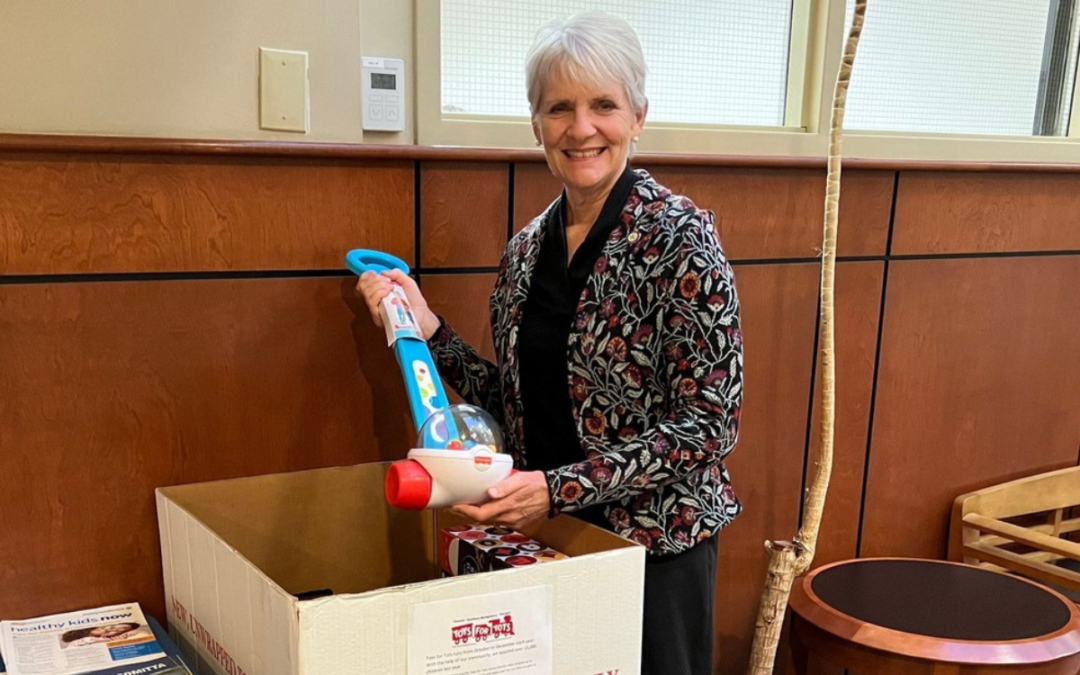
West Chester, Pa (November 13, 2024) – As the holiday season quickly approaches, the office of state Senator Carolyn Comitta is collecting donations of new, unwrapped toys for the Marine Corps Reserve Toys for Tots program.
“Toys for Tots helps ensure thousands of children in Chester County have brand new presents to call their own during the holiday season,” Comitta said “If you are able, please consider donating a toy to help brighten the holiday of a child in our community.”
Donations will be accepted in the atrium at Senator Comitta’s West Chester district office building at 17 E. Gay Street. The office is open during regular business hours, Monday through Friday, from 9 a.m. to 5 p.m.
The final day to drop off donations is December 11th.
During the 2023 holiday season, Chester County Toys for Tots distributed nearly 41,000 toys to over 16,000 children.
Families seeking a toy from the program must submit a request form online by Friday, November 15th.
For more information on the program, to request information, a full list of donation drop-off locations, and more visit the Chester County Toys for Tots website at: https://chester-county-pa.toysfortots.org/
It is one of hundreds of local Toys for Tots campaigns that are conducted annually in over 800 communities covering all 50 states, the District of Columbia, and Puerto Rico, Guam, and the Virgin Islands.
Since 1947, the United State Marine Corps Reserve has operated Toys for Tots, a nonprofit charity, to help distribute toys to families facing financial hardship.
###
December 2, 2024
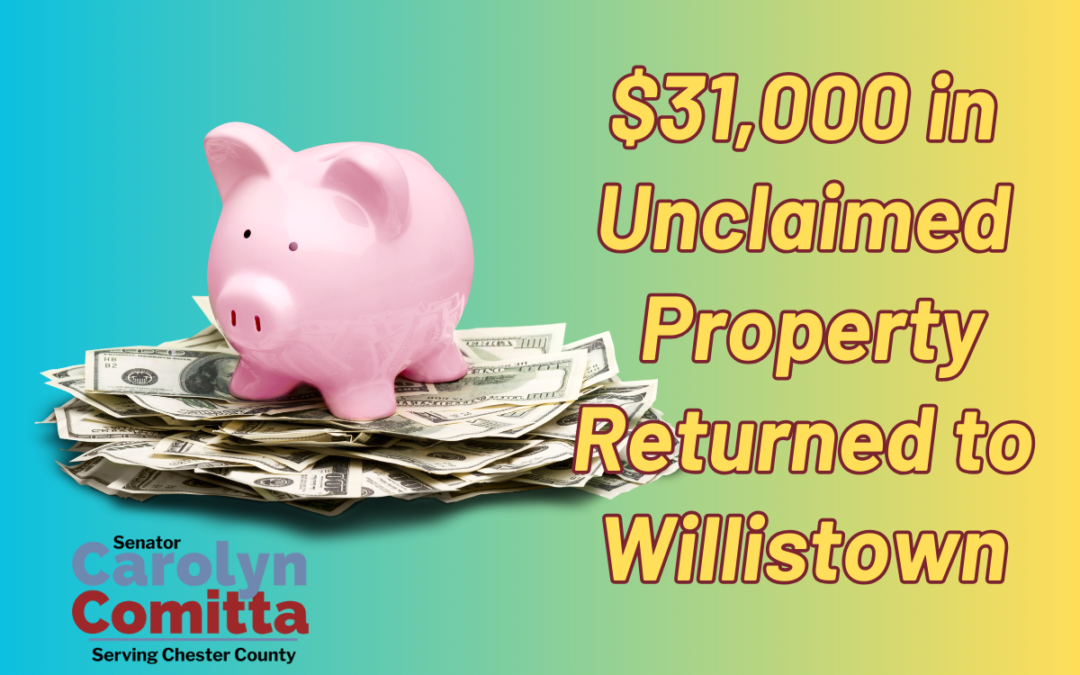
Malvern, PA —State Senator Carolyn Comitta, state Rep. Melissa Shusterman, and Pennsylvania Treasurer Stacy Garrity recently announced that more than $31,000 in unclaimed property has been returned to Willistown Township.
“We are thrilled to see these funds returned to the people and taxpayers of Willistown Township,” Sen. Comitta said. “Our office regularly works to identify local municipalities, school districts, nonprofits, and others who have unclaimed property and connect them with the Pennsylvania Treasury. I thank the Treasury and its staff for their work and encourage more people to check the online database to see if they are owed any unclaimed property.”
“Returning these funds to Willistown Township will significantly benefit our community,” Rep. Shusterman said. “These resources can enhance local services, support essential projects, and ultimately improve the quality of life for our residents. Additionally, the Treasury website has made returning unclaimed property more efficient, and I encourage organizations and residents of my district to contact my office for assistance in claiming any funds.”
“I’m pleased that we’re getting this money back to Willistown Township so it can be used to benefit township residents,” Treasurer Garrity said. “I appreciate working with Sen. Comitta and Rep. Shusterman to return these funds. At Treasury, we want to get unclaimed property back in the hands of the rightful owners – so I encourage everyone, including government agencies, businesses and nonprofits, to check our website regularly to see if any money is available for them to claim.”
The $31,652.08 returned to Willistown Township includes 11 individual properties ranging in value from $20 to $28,788.18. The oldest property dates back to 1998, while the most recent is from 2020. Properties returned include funds from accounts payable checks, a dividend check, escrow accounts, a matured life policy fund, and an unclaimed check/official check. How the funds are spent will be determined by township officials.
Treasurer Garrity has returned more than $17.7 million to nearly 100 local government agencies, including counties and municipalities.
Treasury is working to return more than $4.5 billion in unclaimed property to its rightful owners, including more than $126 million owed to Chester County residents. More than one in ten Pennsylvanians is owed unclaimed property, and the average claim is worth about $1,600.
Unclaimed property can include dormant bank accounts, uncashed checks, insurance policies, contents of forgotten safe deposit boxes and more. State law requires businesses to report unclaimed property to Treasury after three years of dormancy.
Treasury keeps tangible unclaimed property for at least three years before it is auctioned. Auction proceeds are kept in perpetuity for owners to claim. Military decorations and memorabilia are never auctioned.
To learn more about unclaimed property or to search Treasury’s database to see if any money is available for you to claim, visit patreasury.gov/unclaimed-property.

November 22, 2024
West Chester, Pa (November 22, 2024) – Safe Harbor of Chester County will receive 20 laptops to support financial and computer literacy training programs for people recovering from homelessness, state Senator Carolyn Comitta and state Rep. Chris Pielli announced today.
The laptops were awarded through the Pennsylvania Broadband Development Authority’s Digital Connectivity Technology Program. They will support the non-profit organization’s mission to provide emergency housing, food, and support services in a structured environment to unhoused single men and women in Chester County.
“This grant is a powerful step in addressing homelessness by providing the residents at Safe Harbor with the tools they need to rebuild their lives. These laptops will enable access to financial and computer literacy training, giving individuals the skills and confidence to secure housing, employment, and lasting stability. We are profoundly grateful for this investment in hope and opportunity,” said Jessica Chappell, Executive Director of Safe Harbor of Chester County.
“I want to thank the Pennsylvania Broadband Development Authority and Senator John Kane, who serves on the board, for making this investment in our community. Thanks to these laptops, some of our most vulnerable neighbors and community members will now have access to learning the digital skills that are fundamental to a productive life and a prosperous career in the 21st Century,” Comitta said.
“I’m very pleased that Safe Harbor of Chester County has received this essential technology. Safe Harbor is a greatly valued community organization offering comprehensive services for individuals who experience homelessness. These laptops will help bridge the digital divide which disproportionately impacts our most vulnerable residents,” Pielli said. “I applaud the Pennsylvania Department of Community and Economic Development for offering this grant program to enable digital access for individuals seeking employment, education, health resources, and ultimately, long-term self-sufficiency.”
The PBDA is also partnering with the Pennsylvania Department of Labor & Industry and PA CareerLink to introduce program participants to SkillUp™ PA, which offers no-cost online job skills training to the public.
The laptops for Safe Harbor come as part of 9,122 laptops awarded to community institutions across 42 Pennsylvania counties for use by residents who do not have access to digital technology.
Through the Digital Connectivity Technology Program, the Pennsylvania Broadband Development Authority is investing $20 million to provide laptops to eligible public-facing institutions such as libraries, municipalities, workforce training organizations, not-for-profit organizations, and other community anchor institutions.
“The community organizations receiving these devices will help ensure that individuals needing to use a laptop to access high-speed, reliable internet will have that important access,” said Brandon Carson, Executive Director of the Pennsylvania Broadband Development Authority. “Each organization has outlined a clear and effective plan to make these laptops available to individuals in their communities so they have better health, education, and economic outcomes.”
Funded by the American Rescue Plan Act, the Digital Connectivity Technology Program aims to increase access to technology devices where affordability has been identified as a barrier to broadband adoption and use. The program helps ensure that all Pennsylvania communities can access high-speed internet on reliable internet enabled devices so they can enjoy education, career advancement, and telemedicine benefits.
The full list of approvals can be found on the PBDA website. A second round of laptop applications through the Digital Connectivity Technology Program will open in 2025.
###

November 21, 2024
West Chester, Pa (November 21, 2024) – West Chester University was awarded $60,000 in state funding to address student hunger on campus, state Senator Carolyn Comitta announced.
The funding comes through the Pennsylvania Department of Education’s Hunger-Free Campus program, which supports colleges and universities that set up or expand free food pantries on campus and take other steps to meet students’ nutritional needs.
“Too many college students do not know where their next meal is coming from and about one-third report missing meals due to food insecurity,” Comitta, who serves on the Senate Education Committee said. “While we continue to work to make higher education more affordable, I hope these investments help ensure that no student must go hungry to get a degree at West Chester University and other colleges and universities across the Commonwealth.”
Based on legislation introduced by Comitta, the Hunger-Free Campus Initiative was established in the 2022-23 state budget and has since allocated $3 million to eligible Pennsylvania postsecondary institutions to fight food insecurity on their campuses.
This funding for West Chester University (WCU) comes as part of nearly $1 million in PA Hunger-Free Campus grants awarded to 31 institutions of higher education and private licensed schools across the Commonwealth.
This is the third cohort of grant awardees since the program’s creation. Grants are awarded to help schools address food insecurity on campus, including expanding access to food options, creating awareness initiatives, and upgrading facilities.
Previously, WCU was awarded $54,000 and $60,000 through the Hunger-Free Campus program.
“The Shapiro Administration has demonstrated its commitment to keeping students of all ages healthy and fed, and the Hunger-Free Campus grants enable postsecondary institutions to expand access to food and critical services on their campuses,” said Secretary of Education Dr. Khalid N. Mumin. “By sharing best practices and resources, the Hunger-Free Campus coalition is ensuring that learners across the Commonwealth are safe, supported, and cared for while they’re at school.”
Awardees can be found on PDE’s website. Grant funds may be utilized until December 31, 2025.
WCU is a recognized leader in addressing food and basic needs insecurity on campus. All undergraduate and graduate students can access its Resource Pantry, which offers non-perishable food, fresh produce from the campus gardens, personal care items, school supplies, and more.
Last year, WCU’s Center for Civic Engagement & Social Impact utilized the grant funds to expand pantry services through online ordering; increase options for students to access food during evening and weekend hours through online order pickup via locker access; increase access to healthy and allergy-friendly food; support the expansion of the Resource Pantry at the WCU Philadelphia location; build upon resources to support students in applying for benefits through the Supplemental Nutrition Assistance Program (SNAP); and increase students’ access to off-campus resources.
To be eligible for grants, Pennsylvania institutions of higher education must receive the Pa Hunger Free Campus designation. Applications are accepted on a quarterly basis. The deadline to apply is December 31, 2024. Apply online.
For more information on the Pennsylvania Hunger-Free Campus Initiative, contact RA-EDHUNGERFREECAMPUS@pa.gov.
###

November 18, 2024
West Chester, Pa (November 18, 2024) – Six projects that aim to protect watersheds, preserve natural spaces, and expand opportunities for outdoor recreation with new and trail upgrades were awarded state funding, state Senator Carolyn Comitta announced.
“These investments mean more opportunities for Chester County residents, families, and visitors to get outside, stay active, connect with nature, and enjoy the many parks, trails, waterways, and environmental treasures that our region has to offer,” Comitta, who serves as minority chair of the Environmental Resources and Energy Committee, said. “Furthermore, investments in parks and outdoor recreation not only benefit our health and well-being, but they also help drive economic growth.”
The projects, funded through the Pennsylvania Department of Conservation and Natural Resources (DCNR) Community Conservation Partnerships Program (C2P2), are as follows:
- $1,050,000 for West Whiteland Township for the further development of Exton Park, including pedestrian walkways, an internal loop trail, a multipurpose field, playing courts, a pavilion, new play equipment with safety surfacing, ADA access, a parking area, landscaping, signage, and stormwater management measures.
- $1 million for the Willistown Conservation Trust to acquire approximately 90 acres along Providence Road in Willistown for a new nature preserve.
- $500,000 for Chester County for design work, including drawings, specifications and documents, related to the rehabilitation of the Downingtown Trestle Bridge on the Chester Valley Trail in East Caln and West Bradford
- $393,000 for Chester County for the acquisition of approximately 5.27 acres on Boot Road in East Caln to provide a trailhead on the Chester Valley Trail.
- $75,000 for Chester County to coordinate and fund the 2025 Open Space Accelerator program to develop open space implementation plans for municipalities in Chester County.
- $50,000 for the Brandywine Red Clay Alliance to plant approximately 6 acres of meadows and 3 acres of riparian forest buffers in the Lower Delaware River and Lower Susquehanna River watersheds.
“Every day, my Administration is focused on getting stuff done for the good people of Pennsylvania — and we’re proud to support hundreds of projects across the Commonwealth that not only enhance the quality of life for Pennsylvanians but also serve as a catalyst for economic growth,” said Governor Josh Shapiro. “Investing in these projects – from improving our parks and trails to planting trees in our neighborhoods to increasing access to our rivers – attracts visitors to Pennsylvania, boosts local businesses, and strengthens our communities.”
The Chester County projects, which amount to more than $3 million in total funding, come as part of 79.4 million in C2P2 grants awarded to 307 projects across 57 Pennsylvania counties. Statewide, the investments will facilitate the development of 25 new local parks, the rehabilitation of 85 existing parks, the protection of over 6,800 acres for recreation and habitat preservation, and $10 million to support trails.
C2P2 supports projects that develop new parks, rehabilitate existing spaces, and protect vital natural habitats. With increased state and federal support, $10.5 million of this funding round will go toward tree planting and lawn-to-habitat conversions statewide.
The C2P2 grant program is funded by a variety of state and federal funding sources. The Chester County projects were funded through the Environmental Stewardship Fund, Keystone Fund, and the Land and Water Conservation Fund.
###
November 14, 2024
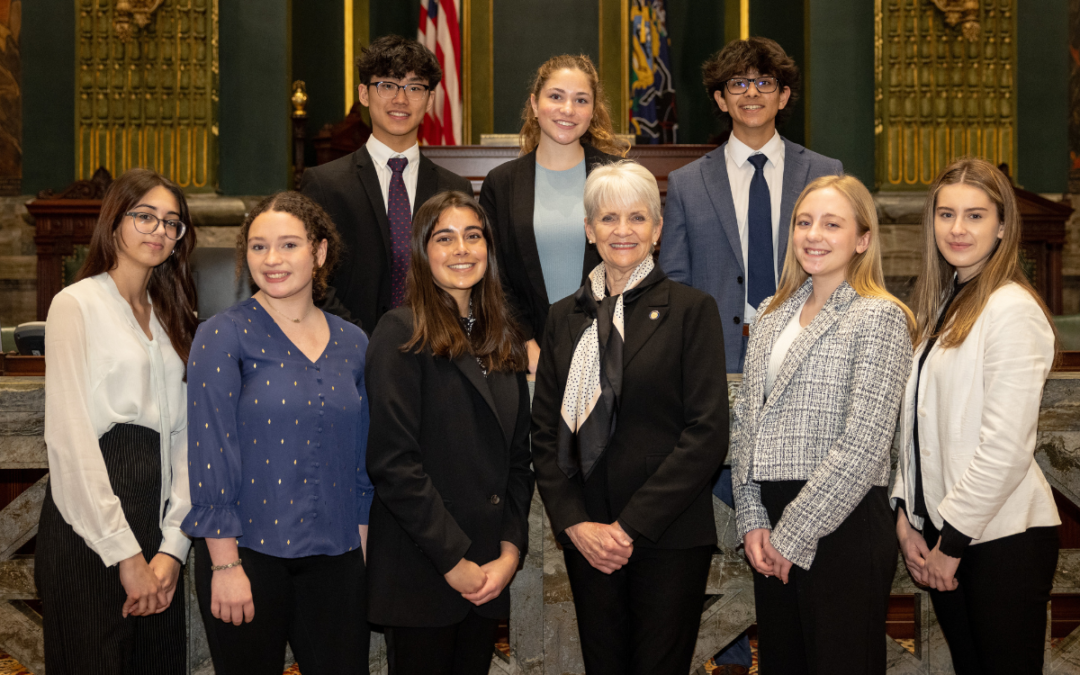
West Chester, Pa (November 14, 2024) – High school juniors who are interested in public service, policy, and the legislative process are invited to apply for state Senator Carolyn Comitta’s 3rd Annual Student Advisory Council.
“One of my favorite things about being state Senator is the opportunity to work with and help foster the next generation of leaders and public servants, and that includes extending opportunities for students to learn more about the legislative process,” Comitta said. “I encourage high school juniors with a passion for public service to apply for this opportunity to learn more about state government and local civic engagement.”
The purpose of the council is to bring together students from across Chester County to learn about the roles and responsibilities within a state senate office as well as gather youth perspectives on the most pressing issues facing communities in Chester County and across the Commonwealth.
Sophie Rivell, a Henderson High School senior who participated in the council last year, encouraged others to apply.
“As a now senior, I can confidently say that Senator Comitta’s Student Advisory Council was the most impactful activity I did in high school. I learned so much about being a socially responsible political leader and have gained so many opportunities from my time on the council to continue using my voice for good,” Rivell said. “To be honest, I was very nervous to apply but am so grateful I did, it was truly a life changing experience both personally and professionally!”
Council members must live in the 19th Senatorial District and are expected to be available for a weekly meeting every Wednesday from 4 to 6 p.m. beginning January 29th running through the beginning of April.
Students can apply by going to pasenatorcomitta.com/studentadvisorycouncil2025. Applications are due by December 13th at 5 p.m.
Upon submission of an application, students may be contacted for an interview.
Student applicants will be selected based on their demonstrated passion for service, prior experience and volunteer opportunities, and enthusiasm for progress through public policy.
For questions about the council and the application process, interested applicants can contact Senator Comitta’s Director of Constituent Services, Ethan Shaffer, at ethan.shaffer@pasenate.com

November 13, 2024
West Chester, Pa (November 13, 2024) – Brandywine Valley Active Aging’s Coatesville Campus is renovating its commercial kitchen to offer affordable meals to more senior citizens thanks to state funding secured by state Senator Carolyn Comitta.
The $100,000 in grant funding, which comes through the Pennsylvania Department of Community and Economic Development, will be used to upgrade the facility’s existing commissary. The improvements are expected to enhance efficiency by an estimated 85 percent.
“Since the pandemic, Brandywine Valley Active Aging has seen a 235% increase in the noon meal program – serving nearly 300 chef-inspired and freshly prepared lunches each day. The funds awarded will see a long-term impact in improving the quality of life for older adults throughout Chester County,” said Bill Pierce, BVAA Executive Director.
To help seniors maintain a healthy weight and access balanced meals, BVAA offers nutritious, reduced-cost lunch options Monday through Friday.
“I appreciate the staff and volunteers who support our older friends and neighbors at Brandywine Valley Active Aging and all our senior community centers throughout Chester County and Pennsylvania,” said Comitta, who serves on the Senate Aging and Youth Committee. “This investment will ensure that more senior citizens in the Coatesville area can access healthy, affordable, and delicious meals for years to come.”
In 2021, the Coatesville and Downingtown Senior Centers merged to form BVAA, a nonprofit organization that serves as the leading resource for older adults in the greater Coatesville and Downingtown area and operates campuses in both communities.
In addition to offering meals and supplementary nutrition, BVAA provides opportunities for socialization, exercise, art and educational programs, and other services that aim to enrich and enhance the health, wellness, dignity, and overall quality of the life for older adults.
For more information about BVAA, visit bvactiveaging.org
###
November 12, 2024
West Chester, PA — State Senator Carolyn Comitta and Pennsylvania Treasurer Stacy Garrity recently announced that nearly $15,000 in unclaimed property has been returned to the Borough of West Chester in Chester County.
“We are always happy to help return unclaimed property to its rightful owners, in this case the people and taxpayers of West Chester Borough. Our office regularly works to identify local municipalities, school districts, nonprofits, and others who have unclaimed property and connect them with the Pennsylvania Treasury to expedite the process,” Comitta said. “We appreciate the Treasury and its staff for their ongoing efforts to reunite people and entities with their unclaimed assets.”
“Working with Senator Comitta to return this money to West Chester was an absolute pleasure,” Treasurer Garrity said. “One of my top priorities is getting the more than $4.5 billion of unclaimed property in Treasury’s vault back to its rightful owners – whether that be individuals, businesses, nonprofits, or local government agencies like the borough. It’s great news that this money can now be put to good use for the residents of West Chester.”
The $14,858.56 returned to West Chester includes 29 individual properties ranging in value from $9.19 to $6,904. The oldest property dates back to 2001, while the most recent is from 2020. Properties returned include funds from accounts payable checks, cashier’s checks, claims payment checks, credit balances, escrow accounts, premium refunds, refunds/rebates, and uncashed checks. How the funds are spent will be determined by borough officials.
Treasurer Garrity has returned more than $17.7 million to nearly 100 local government agencies, including counties and municipalities.
Treasury is working to return more than $4.5 billion in unclaimed property to its rightful owners. More than one in ten Pennsylvanians is owed unclaimed property, and the average claim is worth about $1,600.
Unclaimed property can include dormant bank accounts, uncashed checks, insurance policies, contents of forgotten safe deposit boxes and more. State law requires businesses to report unclaimed property to Treasury after three years of dormancy.
Treasury keeps tangible unclaimed property for about three years before it is auctioned. Auction proceeds are kept in perpetuity for owners to claim. Military decorations and memorabilia are never auctioned.
To learn more about unclaimed property or to search Treasury’s database, visit patreasury.gov/unclaimed-property.

November 6, 2024
West Chester, Pa (November 6, 2024) – The Chester County Association for the Blind and Visually Impaired (CCABVI) is expanding its services to reach more people and community members, thanks to state funding secured by state Senator Carolyn Comitta.
Comitta recently secured $25,000 in state grant funding through the Pennsylvania Department of Human Services for CCABVI to expand its “library” of vision support equipment that can be loaned to those in need for extended periods of time.
“We offer thanks to the office of State Senator Carolyn Comitta for its guidance and assistance in procuring these funds,” said Tracey Melia, CCABVI Board President.
According to Melia, the nonprofit organization offers a demonstration lab on site with the support equipment as well as a traveling demonstration “kit” that can be used in assisting the homebound. In addition, the funds will be used to hire an occupational therapist who can conduct home visits to its caseload of 480 individuals.
“The Chester County Association for the Blind and Visually Impaired has served Chester County for more than 70 years. I am proud to secure this funding to help even more people with blindness or vision loss live safe, happy, healthy, productive and independent lives,” Comitta said.
The mission of the CCABVI is to prevent blindness and vision impairment through public education and improve the quality of life for those experiencing blindness or vision loss through direct service or referral.
CCABVI provides referrals for free eye exams and glasses to those in need and offers employment opportunities to the blind and visually impaired at an on-site textile workshop.
For more information on the CCABVI and its services, visit www.chescoblind.org.

November 1, 2024
West Chester, Pa (November 1, 2024) – Five projects that improve municipal services, support outdoor recreation, expand access to healthcare, and invest in educational opportunities were awarded $3.8 million in total state funding, state Senator Carolyn Comitta announced today.
“Strong municipal services and public works, access to world-class healthcare, top-notch educational facilities and programs, and extensive opportunities to enjoy the natural beauty of the outdoors – these are all part of our excellent quality of life in Chester County. As state Senator, I continue to support investments in these community assets, so they can be enjoyed by all people now and for generations to come” Comitta said.
The funds, which were awarded through the Redevelopment Assistance Capital Program (RACP), are as follows:
- $1 million to East Fallowfield Township for a new municipal complex. The township has already conducted a feasibility study on the complex, which will combine the police department and administrative offices. The funds will support construction and related activities, including land development, site work, highway occupancy permitting, and an extension for the public water and sewer. Funding will also help purchase equipment for the new municipal complex, like access control, security, and furniture.
- $1 million for Paoli Hospital to add more patient rooms by renovating an existing medical building into a patient care unit. The project, which will result in additional patient rooms, is part of is a short-term strategy to accommodate increased inpatient volume. Longer-term campus master planning is underway with a focus on further increasing inpatient bed capacity at Paoli Hospital to meet the current (and growing) demand.
- $800,000 for West Whiteland Township to support the construction of the township’s new public works facility.
- $500,000 for the Chester County Intermediate Unit for the construction of the Child and Career Development Center’s new Great Valley campus. The new campus, situated on 22 acres in East Whiteland Township, accommodate 190 students from across the county. It is being designed to accommodate students with multiple disabilities, including physical and emotional challenges. It will include specialized gymnasiums, therapy centers, classrooms, emotional support, and physical support areas, including outdoor all-abilities playgrounds and recreation areas. Construction on the campus broke ground earlier this past summer and is expected to be completed in September 2026.
- $500,000 for Natural Lands to make improvements at the Stroud Preserve in East Bradford. Funds will be used to demolish and reconstruct an aging bridge, construction of a new bathroom facility, repaving, and stormwater management and flood mitigation improvements.
The Redevelopment Assistance Capital Program is a state grant program administered by the Office of the Budget for the acquisition and construction of regional economic, cultural, civic, recreational, and historical improvement projects.
To receive funding, projects must have a regional or multi-jurisdictional impact and generate substantial increases or maintain current levels of employment, tax revenues, or other measures of economic activity.
Through her leadership in the legislature, Comitta has brought back tens of millions of dollars in RACP funding to support various community revitalization and economic development projects benefitting the people of Chester County.
October 31, 2024
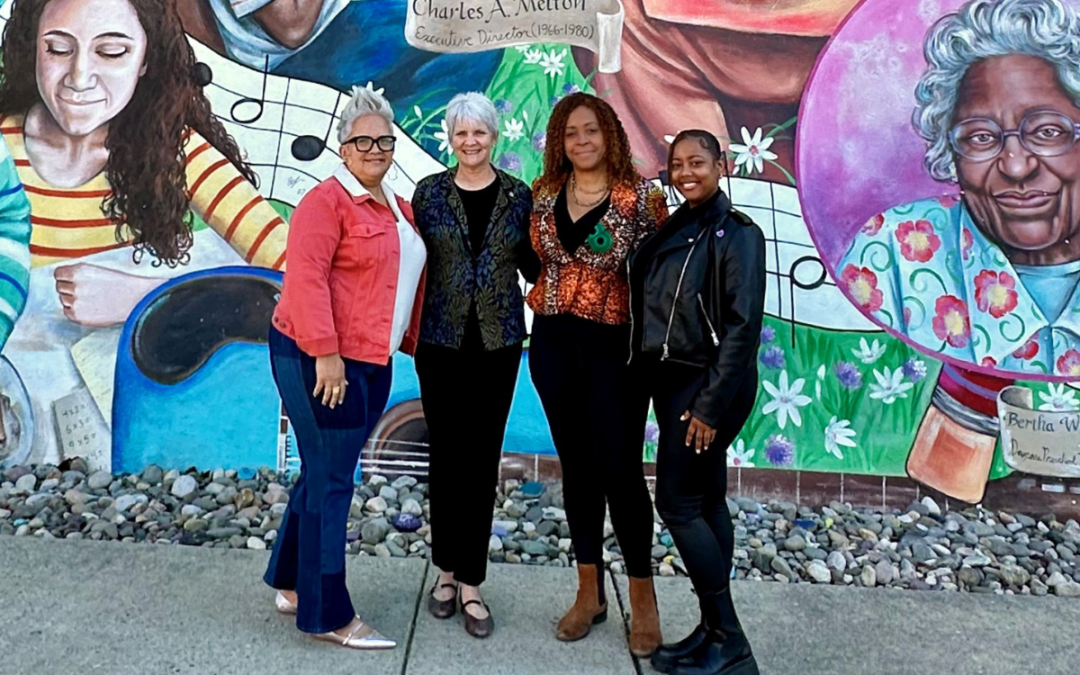
West Chester, Pa (October 31, 2024) – The Charles A. Melton Art and Education Center is getting a new digital marquee and a repaved parking lot thanks to state funding secured by state Senator Carolyn Comitta.
The $62,000 grant comes through the Pennsylvania Department of Community and Economic Development’s Keystone Communities Initiative Program.
Melton Center officials said the new marquee and parking lot improvements will help the nonprofit organization welcome more children, families, and people to take advantage of its growing array of offerings, including youth and adult sports leagues, health and wellness screenings, arts programs, educational activities, a community café, and a new childcare center.
“The Melton Center is and has always been a special place in East End of West Chester where everyone can come together and access resources and programs to help us grow together and thrive together,” said Comitta, who previously served as Mayor of West Chester. “I am thrilled to secure this support and hope it helps a whole new generation of children and families continue to access, enjoy, and benefit from this community asset.”
“The Charles A. Melton Art and Education Center is more than just a place to play sports; it’s a catalyst for community and personal growth and development. By nurturing creativity and providing opportunities for education and engagement, we’re fostering a vibrant, thriving community that attracts a diverse clientele, and visitors from far and wide. This support will allow the Melton Center to attract more visitors with safer parking and a digital marquee to advertise our activities and events. We would like to thank Senator Comitta and the Pennsylvania Department of Community and Economic Development for their continuous support,” said Ken Winston, Executive Director of the Melton Center.
For more information about the Melton Center and its programs, visit westchestercommunitycenter.org

October 25, 2024
West Chester, Pa (October 25, 2024) – In recognition of their ongoing work to support the health of mothers, children, and families, state Senator Carolyn Comitta and her team were honored with the Community Partner Award from the Maternal and Child Health Consortium of Chester County (MCHC).
“I am honored to share this award with all of our partners In Chester County we are fortunate to have so many people and organizations, like MCHC, that are dedicated to creating a better, brighter future for this generation and the next one,” said Comitta, who serves in the Senate Women’s Health Caucus. “I want to thank my team and all of the staff and volunteers at MCHC for their work on behalf of safe, healthy, and happy communities.”
Milena Lanz, the Executive Director of MCHC, expressed the nonprofit organization’s “sincere gratitude for the invaluable support and partnership that Senator Comitta and her staff have provided for several years in furthering our mission.”
Lanz was also honored at the event for more than 25 years of dedicated service to nonprofits throughout the Greater Philadelphia area.
They were honored at MCHC’s annual Celebrating Families Dinner and Silent Auction.
Comitta has been working closely with MCHC since her time as State Representative. Now, as state Senator, she is expanding her work to support expectant and new moms and families by:
- Securing $50,000 for MCHC to provide one-on-one support throughout pregnancy.
- Hosting her first annual Community Baby Shower in partnership with MCHC.
- Holding a diaper drive and a book drive to sustain resources for MCHC families.
- Supporting a $2.6 million investment to prevent maternal mortality in this year’s state budget.
- Extending post-partum care to one year (instead of 60 days) for mothers on Medicaid in Pennsylvania.
- Passing legislation (House Bill 2127) to provide new mothers with greater access to resources to address postpartum depression.
- Passing legislation (House Bill 1608) to extend Medicaid coverage to doula services.
- Supporting legislation (Senate Bill 1262) to modernize the regulations governing midwives.
- Joining the Black Maternal Health Caucus to combat racial disparities in maternal healthcare.
-
The Maternal and Child Health Consortium of Chester County is a nonprofit dedicated to ensuring that children and families have the skills, knowledge, and resources to start healthy, stay healthy, and succeed in school. To learn more, visit ccmchc.org

October 24, 2024
West Chester, Pa (October 23, 2024) – The Downingtown Area School District will receive more than $1.1 million in state funding to replace windows at two elementary schools, state Senator Carolyn Comitta, state Rep. Christina Sappey, and state Rep. Danielle Friel Otten announced.
The funding, which comes through the Pennsylvania Department of Community and Economic Development’s Public School Facility Improvement Grant Program, was approved today by the Commonwealth Finance Authority:
The grants are as follows:
- $618,000 to replace 92 windows at Bradford Heights Elementary School. The school’s current sliding windows are inoperable due to corrosion and its double-hung windows have deteriorated perimeter gaskets that allow air infiltration. The new windows will provide energy savings, as well as health and safety benefits through improved air quality and easier, safer operation. The new windows also feature simpler locking mechanisms that enhance security.
- $550,000 to replace the windows at the East Ward Elementary School. The windows from the original 1964 building are energy inefficient and present safety risks. Meanwhile, the school’s 1996 addition has wood-clad windows, which have deteriorated to the point that they can no longer be locked. The proposed window replacement will improve air quality and enhance safety and security by featuring appropriate opening height and functional locking mechanisms.
In addition, the Downingtown Area School District was also awarded $40,000 in state funding to replace 29 automatic external defibrillators (AEDs) that are beyond their recommended lifespan. The investment will help ensure that students, teachers, and staff in the district’s 16 school buildings have access to tools to respond to life-threatening health emergencies.
“These investments help ensure that our schools remain safe, healthy, and productive places for students to learn and teachers to teach. As a former public school educator, I know that families entrust our schools with the well-being of their children each day,” Comitta, who serves on the Senate Education Committee, said. “These funds will save energy costs while enhancing security and ensuring we’re prepared to adequately respond to life-threatening cardiac emergencies.”
“I’m always happy when we can provide a win for everyone. These school district window projects are cost-saving investments that save taxpayer money, improve energy efficiency and indoor air quality. I’m also extremely pleased that Downingtown will be able to replace expired AED’s with this funding. I’m very proud of their work to prevent sudden cardiac arrest,” Sappey said.
“Investment in our school facilities is essential for the health and safety of students and staff,” Otten said. “This funding will help Downingtown Area School District address safety and energy loss concerns by replacing old, inefficient windows in two elementary school buildings. These grants will also potentially save lives, as a portion of the funds will help to pay for the replacement of 29 AED units districtwide that are beyond their recommended lifespan.”
The Pennsylvania Public School Facility Improvement Grant Program provides grants to public school districts and area career and technical schools for eligible facility improvement projects.
The program was funded with a $100 million allocation in this year’s state budget.
###
October 23, 2024
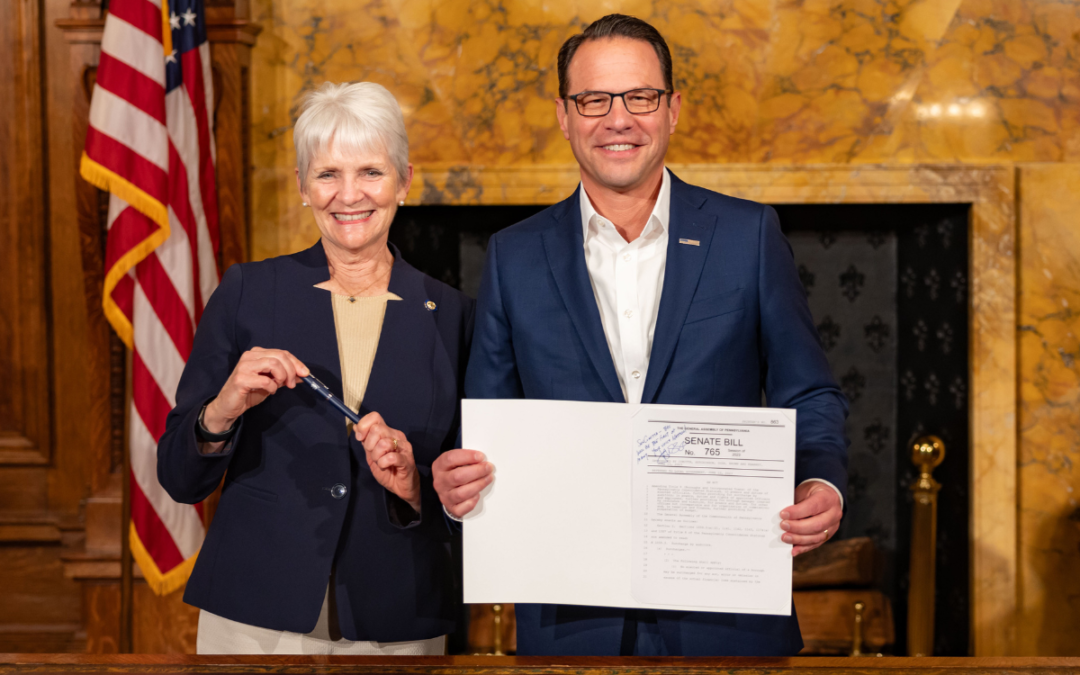
West Chester, Pa (October 22, 2024) – Legislation introduced by state Senator Carolyn Comitta to update the Pennsylvania Borough Code was signed into law this week by Governor Josh Shapiro.
Senate Bill 765, signed into law as Act 110 of 2024, makes changes to modernize the Borough Code, ensuring it aligns with recent revisions to the First Class Township Code.
“These changes aim to help boroughs operate with more flexibility, autonomy, and consistency,” said Comitta, who serves on the Senate Local Government Committee.
The legislation, supported by the Pennsylvania State Association of Boroughs, passed the Senate in June and the House earlier this month.
Comitta, a former West Chester Mayor and West Chester Borough Council member, also serves on the Pennsylvania Local Government Commission.
Pennsylvania is home to 955 borough governments, including 15 in Chester County.
###
October 22, 2024
West Chester, Pa (October 22, 2024) – Fifteen local municipalities throughout Chester County were awarded state grant funding for projects that support public safety, revitalize historic downtowns, improve stormwater and wastewater management, install new bridges and sidewalks, and invest in renewable energy, members of the Chester County State Legislative Delegation announced.
The twenty-two projects that were awarded funding are represented by state Senator Carolyn Comitta and State Representatives Christina Sappey, Chris Pielli, Dan Williams, Danielle Friel Otten, Melissa Shusterman, and Kristine Howard. In total, they amount to a $7.4 million state investment in Chester County municipalities and local communities.
“As a former mayor, I know just how important these investments are to local communities and municipalities. In the state Senate, I continue to work to secure funds that directly benefit the health, safety, prosperity and quality of life of residents, workers, and families throughout Chester County,” said Comitta.
“I am pleased to work alongside Senator Comitta to support funding for these projects that invest in the longevity of our infrastructure and keep our communities safe and up to date,” Sappey said. “It is the direct result of strong state and local partnerships that work to combine resources and address needs.”
“I am thrilled and extremely grateful that the work Senator Comitta and I are doing in Harrisburg has helped to deliver to our District this important funding improving the health, safety, and welfare of our community,” Pielli said.
“I’m very proud we’ve secured this funding to strengthen our first responders. The new equipment this funding provides will enable them to come to our aid more quickly in times of crisis. We can all feel safer knowing that they have the tools to ensure our safety and welfare,” said Williams.
“Flooding is a significant concern in Downingtown Borough, and this state funding will help borough officials mitigate impacts to residents and promote public safety,” Otten said. “I am pleased to help bring funding dollars back to the district for these essential projects, and I applaud the Borough for their proactive efforts to protect residents and prepare for future storms and flooding events.”
“Willistown’s aging sewer system is under increasing strain as our community grows. These grants will help modernize the existing wastewater management system so it can continue to serve residents and enable new ones to be connected,” said Shusterman.
“Investments in safe, walkable streets will improve the economic, cultural, and physical health of our neighborhoods. This grant will encourage everyone to get out for a walk, stop by a local business, or meet up with a friend. It’s an investment in people,” Shusterman added.
“This is a tremendous boon to the district,” Howard said. “From revitalization efforts to solar power installation to flood mitigation, these grant dollars will ensure that Chester County remains among the best places to live in Pennsylvania.”
The funds, which come through the Pennsylvania Department of Community and Economic Development’s Local Share Account Program, were approved today by the Commonwealth Financing Authority.
They are as follows:
Public Safety and Emergency Services:
- $675,000 for the City of Coatesville to purchase two new pieces of fire equipment: a Seagrave Pumper Fire Engine, and a Seagrave Tractor-Drawn Aerial Apparatus Ladder Truck (Comitta, Williams).
- $550,000 for East Goshen Township to purchase a new fire truck pumper for Goshen Fire Company (Comitta, Pielli).
- $495,000 for Malvern Borough to purchase a new, larger 3,000-gallon pumper-tanker truck (Comitta, Howard).
- $451,000 for Modena Borough to support the purchase of two 2024 Ford F-550 diesel ambulances for Modena Fire Company 1 (Comitta, Williams).
- $93,000 for Modena Borough to purchase medical and safety equipment for emergency medical service first responders at Modena Fire Company 1 (Comitta, Williams).
- $57,000 for South Coatesville Borough to replace aging computers and purchase a license plate reader for its police department (Comitta, Williams).
Stormwater, Sewer, and Wastewater Management:
- $25,000 for Downingtown Borough to purchase and install new flood monitoring equipment along the East Branch of the Brandywine Creek as part of an upgraded system to alert and notify residents during flood events (Comitta, Otten).
- $500,000 for East Caln Township to construct stormwater inlets and roadway swales along Downing Road and Downing Circle (Comitta, Howard).
- $500,000 for West Bradford Township for upgrades to the Dupont Wastewater Treatment Plant (Comitta, Sappey).
- $750,000 for West Chester Borough to upgrade the Goose Creek Sanitary Sewer with larger pipes (Comitta, Pielli).
- $600,000 for Willistown Township to replace aging equipment at Pump Station 3 and evaluate the condition of its sewer system by cleaning and televising the sewers, which date back to the 1970s (Comitta, Shusterman).
- $175,000 for Willistown Township to connect 13 properties on West Chester Pike to public sewers (Comitta, Shusterman).
Bridges and Sidewalks:
- $505,000 for Easttown Township to complete a streets initiative focused on the Route 30 corridor in the Village of Berwyn (Comitta, Shusterman).
- $350,000 for East Bradford Township to stabilize a bridge and streambank along Ravine Road (Comitta, Pielli).
- $250,000 for East Fallowfield Township to replace a failing underground culvert pipe located at a stream crossing underneath Saw Mill Road (Comitta, Sappey).
- $85,000 for West Goshen Township to install approximately 350 feet of sidewalk along the south side of West Rosedale Avenue (Comitta, Pielli).
Community Revitalization:
- $50,000 for Malvern Borough to prepare a revitalization plan for the nine-block-long King Street business district (Comitta, Howard).
Municipal Upgrades:
- $685,000 for South Coatesville Borough to restore the administration building, which was significantly damaged by flooding from Hurricane Ida in 2002 (Comitta, Williams).
- $50,000 for Valley Township to install security fencing and automated gates at the Valley Township municipal complex and public works garage (Comitta, Williams).
- $500,000 for West Whiteland Township to construct an on-site solar array at its public works facility to support the goal of running the facility and garage completely on clean, renewable energy (Comitta, Howard).
- $44,000 for West Whiteland Township to install a ground-mounted solar photovoltaic array on the grounds of Boot Road Park to power the park’s exterior lighting and public recreational facility. The solar array is expected to save the township $1,400 and reduce emissions by one metric ton of CO2 annually (Comitta, Howard).
The Local Share Account program is designed to distribute funds derived from gaming revenue to support community and economic development projects.
Eligible applicants include counties, municipalities, municipal authorities, economic development agencies, redevelopment authorities, land banks, and councils of government. Eligible projects must improve the quality of life of citizens in the community and must be owned and maintained by an eligible applicant or a nonprofit organization.
###