
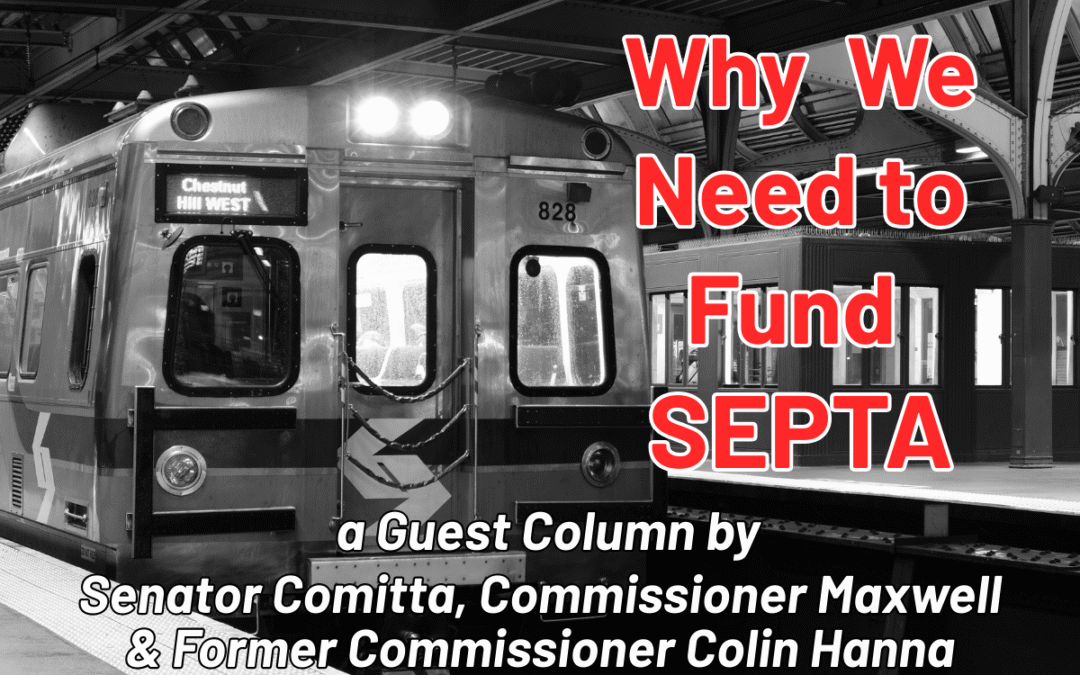
NOTE: The following guest column appeared in the Opinion Section of the Daily Local News online on September 4, 2025.
By Carolyn Comitta, Josh Maxwell, and Colin Hanna
What would the region’s daily commute like look with thousands of additional drivers on Route 202, Interstate 95, and the Schuylkill Expressway? What would happen to businesses, large and small, without buses and trains to take people to work and school? And what would Philadelphia’s Main Line suburbs be without rail service on the Main Line?
As a state senator serving Chester County, the chair of the Chester County commissioners and Delaware Valley Regional Planning Commission and a former Chester County Commissioner and DVRPC chair, we know that our transportation system operates as a whole. Roads, bridges, buses, trains and trolleys all work together to get people where they need to go.
If you don’t take SEPTA and think you’re immune from the transit crisis, think again. Not only will our roads in Southeastern Pennsylvania have significantly more traffic (275,000 additional vehicles or roughly the population of Pittsburgh every day), but all those tires will take a big toll on our transportation infrastructure. And if the idea of longer trips, slower travel, and more potholes isn’t bad enough, imagine the impact of an estimated 2 million additional vehicle miles on our air quality.
Think SEPTA should have better accountability and oversight over taxpayer dollars? We do, too. That’s why the most recent bills to come out of both the Democratic-controlled state House and Republican-controlled Senate include more of both, as well as additional independent audits each year and criteria to improve performance and crack down on fare evasion.
Despite current political divisions, this shouldn’t be a partisan issue. Nor should it be a geographic one. Keep in mind, this isn’t just about SEPTA. Other transit agencies are facing similar challenges. The transit funding package that we’re talking about invests in 52 transit systems that serve nearly 1 million riders each day in rural, urban and suburban communities across the Pennsylvania. It also includes significant funding for road and bridge repairs, all without raising taxes.
That said, there is no question that SEPTA must be managed effectively and efficiently. And to continue to attract ridership, which is still rebounding from the pandemic, SEPTA service must be reliable, clean, safe, welcoming and affordable. However, let’s put to bed the myth that SEPTA should or could be self-sufficient. There is not a single mass transit agency in the world that runs without government support. The reality is less than a quarter of SEPTA’s budget comes from fares, which is in line with transit agencies across the nation. Meanwhile, over the past decade, SEPTA has seen roughly half as much public investment, on average, as its counterparts in other U.S. cities.
Still not convinced? Try getting to (and parking at) a Phillies, Eagles, Flyers or Sixers game with fewer trains and buses, no more special trips to the stadiums and an end to all SEPTA service at 9 p.m. Never mind the major events coming to Philadelphia in the next year such as America 250, the NCAA men’s basketball Tournament, the PGA Championship, the FIFA World Cup and the MLB All-Star Game. And how about taking Amtrak to Harrisburg or New York? Amtrak’s Keystone Line could be impacted by the cuts since SEPTA leases rail lines from Amtrak.
As SEPTA service cuts and fare increases take effect, we call on all legislators in the Senate to adequately fund SEPTA and stop the potential for logistical disruptions and economic devastation on a scale never seen. While we appreciate that the regional rail cuts are on hold due to a court order, we fear that if they take place, it will be an uphill battle to restore service and get back on track.
The legislature established SEPTA more than 60 years ago to replace fragmented and financially failing private transit providers with a unified, publicly funded regional system. Over the decades, it has become a staple of life in our region. Sure, SEPTA is not perfect, but on any given day, you’ll see workers, medical professionals, students, senior citizens, visitors, families, and more relying on it to get where they need to go.
Today, state lawmakers need to keep the promise and fund SEPTA. We need Democrats and Republicans to come together and work together. And we need them to do it now. After all, with Chester County continuing to lead the commonwealth in growth, a new train station in Paoli and design work complete in Downingtown, we need SEPTA more than ever.
Carolyn Comitta, a Chester County Democrat, represents the 19th District. Josh Maxwell, a Democrat, is chair of the Chester County commissioners and Delaware Valley Regional Planning Commission. Colin Hanna, a Republican, is a former Chester County commissioner and DVRPC chair.