
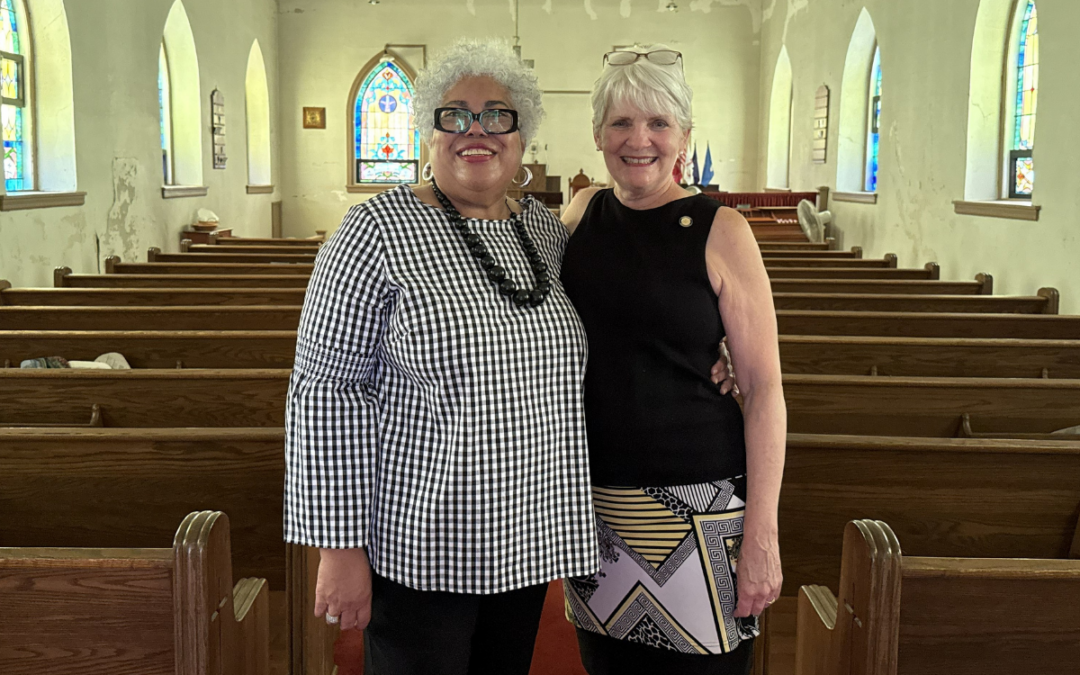
Devon, PA (July 22, 2026) – A historic Main Line church that played a key role in the Civil Rights movement and the fight against school segregation is getting some much-needed infrastructure upgrades, thanks to grant funding secured by State Senator Carolyn Comitta.
Mt. Zion African Methodist Episcopal (AME) Church is receiving $50,000 in state funding to repair water damage to the historic structure, which was built in 1861. It is considered the first recorded and oldest African Methodist Episcopal Church on the entire Main Line. In the 1930s, the church served as an important meeting place for African American families and leaders opposed to segregation policies in Tredyffrin and Easttown schools.
“Many of us think of school segregation battles taking place in the deep south, but the fight for Civil Rights and equality in education extended into our area,” Comitta said. “It’s important that we continue to tell these stories, share their lessons, and preserve our historic places as part of American history. I want to thank the Rev. April M. Martin, pastor of Mt. Zion AME Church, and all the congregants and supporters working to preserve this historic site.”
“I am so very grateful to Senator Carolyn Comitta, who understood the urgent call to repair and restore Mt. Zion AME Historic Church in Devon. Its significant history has impacted both our Chester County and the Commonwealth of Pennsylvania,” Martin said.
The church is well-known for its role in “the Berwyn School Fight,” which began in 1932 when school board leaders attempted to impose previously unenforced segregation policies in the districts’ schools. They planned to consolidate all black students, teachers and staff in two older schools, while the existing high school and a new elementary school would be reserved for white students. At that time, the decision was in line with the U.S. Supreme Court 1896 Plessy v. Ferguson ruling that established the doctrine of “separate but equal.”
Since there were very few black-owned businesses and other friendly gathering places in the region, black families met at Mt. Zion AME Church to plan and strategize their protest efforts against the attempt at segregation. They signed a petition, enlisted the help of the NAACP, picketed the school, and even boycotted sending their children.
For a time, some children were taught in the church’s parsonage while others were homeschooled or traveled to nearby schools. Some did not attend school and their parents were threatened with losing their jobs, fined and even arrested and jailed for having “truant” children.
According to Roger Thorne of the Tredyffrin/Easttown Historical Society, who wrote a detailed historical account of the case, the jailings reportedly came to an end when a mother with an infant in her arms refused to pay the fine on principle and agreed to go to jail in place of her husband, so he would not lose his job. Her stand reportedly caused the court to stop arresting parents.
After two years of fighting and national attention on the case, Pennsylvania Attorney General Schnader intervened and in the spring of 1934, the segregation plan was scrapped, and black and white students returned to sharing the same classrooms.
The case had several impacts, including assisting in the passage of the Pennsylvania Equal Rights Bill in 1935, spurring on the organization and coalition-building efforts of the NAACP, and demonstrating the effectiveness of nonviolent resistance strategies and methods that would become the hallmark of the modern Civil Rights movement.
Still, it would be another two decades before the Supreme Court’s landmark Brown v. Board of Education ruling establishing segregation in public schools as unconstitutional.
Mt Zion AME Church is listed on the National Register of Historic Places in 2015, and in 2020, received a historic marker from the Pennsylvania Historical and Museum Commission. Its cemetery is also the final resting place of numerous Civil War Veterans who served in the US Colored Troops (USCT).
Today, plans are in store to fully restore the church and develop an educational center on African American History there.
###