
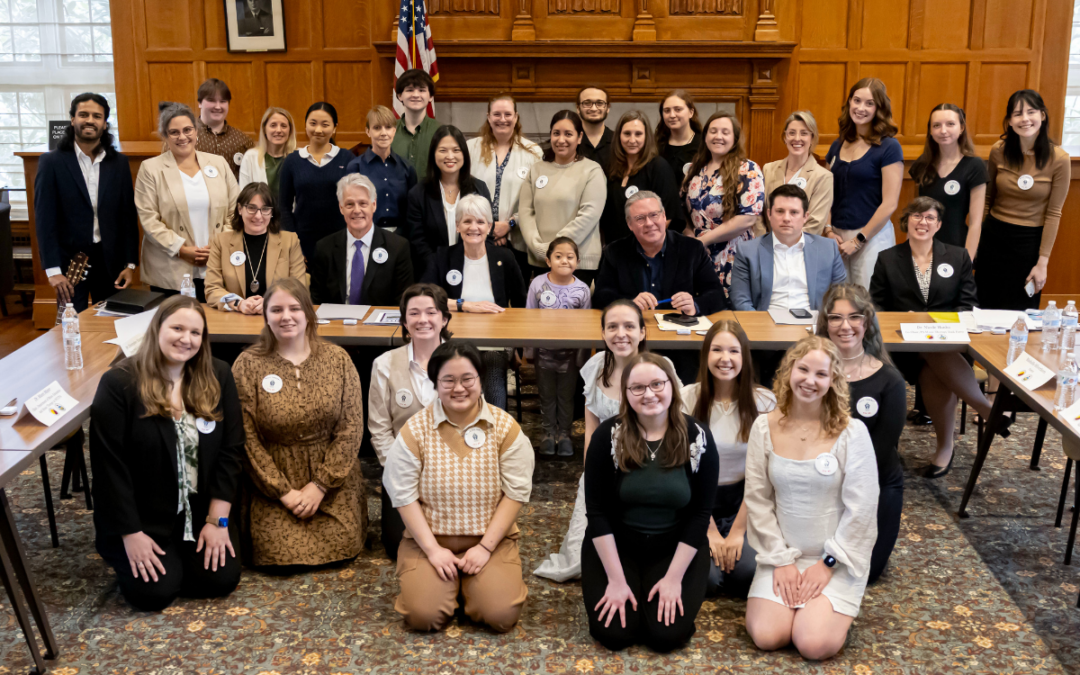
West Chester, Pa (April 21, 2026) – Passing legislation to license professional music therapists in Pennsylvania would expand access to care and bring economic benefits to local communities, State Senator Carolyn Comitta and Pennsylvania Secretary of the Commonwealth Al Schmidt heard at a roundtable discussion this week.
The event, organized by Comitta, the Pennsylvania Music Therapy Force, and the West Chester University Therapy Program, included comments from WCU music therapy students, staff, and alumni, as well as a music therapy demonstration.
Music therapy is an evidence-based healthcare profession that can help reduce stress, anxiety, and depression, ease pain, and improve communication and social skills.
“Music therapy is a non-invasive, medication-free tool that can help people manage pain, process trauma, and recover from illness or injury,” Comitta said. “Music has a healing power and licensing music therapists in Pennsylvania will help more people live healthier lives.”
In the legislature, Comitta partnered with State Senator Elder Vogel to introduce Senate Bill 579, legislation that would offer professional licensure to music therapists in Pennsylvania, encouraging them to work and stay here. It is the companion legislation to House Bill 563, introduced by Rep. Eddie Day Pashinski.
Advocates say it would make music therapy available to more children and families, help ensure practitioners are trained and qualified, retain talented professionals, build up our workforce, lower the cost of care, and generate economic activity.
In fact, by establishing a music therapy license, Pennsylvania could regain approximately $7 million by retaining graduates and $135.4 million by enabling music therapists to bill appropriately, according to the Pennsylvania Music Therapy Task Force.
The bipartisan bill would establish a board-certification exam, continuing education requirements, and a code of ethics for trained music therapists seeking professional licensure under the State Board of Social Workers, Marriage and Family Therapists, and Professional Counselors.
Secretary Schmidt, whose department oversees professional licensure in the Commonwealth, remarked that the discussion and demonstration helped illustrate why licensure would help music therapists thrive rather than create obstacles to care.
Pennsylvania is currently home to more than 600 music therapists serving 49,000 residents each year. They assist clients with a variety of clinical needs, including Alzheimer’s disease, autism spectrum disorders, cerebrovascular accidents (strokes), dementia, depression, developmental and intellectual differences, Parkinson’s disease, post-traumatic stress disorders, terminal illnesses, traumatic brain injuries, visual impairments, and more.
In addition, the therapy roundtable, held in Philips Autograph Library, also featured comments from Dr. Laurie Bernotsky, President of West Chester University; Dr. Christopher Hanning, Dean, Wells School of Music; and representatives from the Mid-Atlantic Region of the American Music Therapy Association